Solving Radical Equations Worksheet
Practise solving radical equations on one free printable worksheet. It starts with isolating a single square root, then gives a whole section to the extraneous solutions that squaring invents, handles radicals on both sides, and finishes with cube roots and rational exponents. Every answer in the key is checked against the original equation, and the rejected ones are named.
Download the worksheet
Three pages of practice and a two-page worked answer key, with every extraneous solution identified and explained.
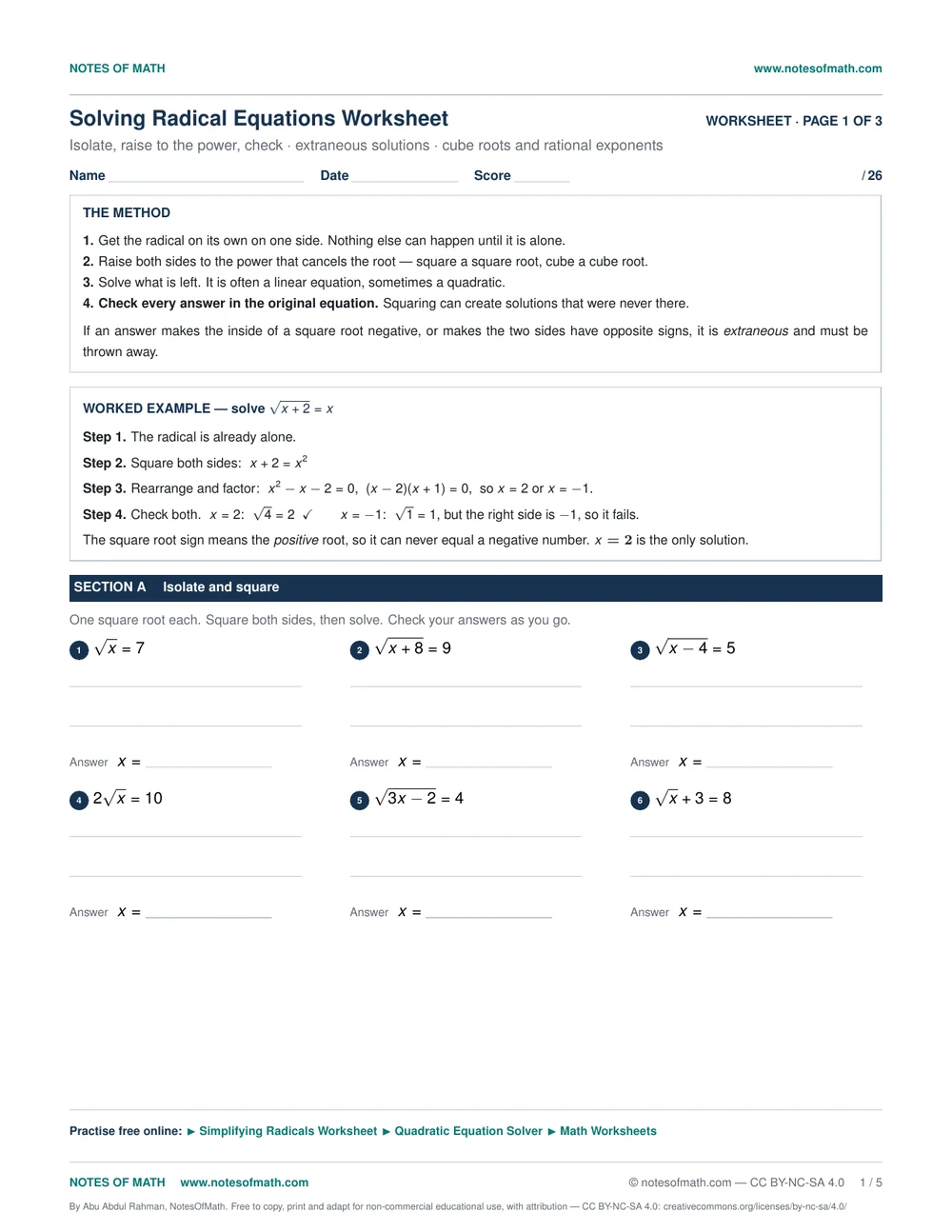
What is on the worksheet
- Section A — isolate and square (6 questions). One square root each, including two where the radical has to be isolated first.
- Section B — extraneous solutions (6 questions). Squaring turns each into a quadratic with two roots, and at least one root is not a solution. This is the section the topic exists for.
- Section C — a radical on each side (5 questions). Square once and both radicals go, then check the inside of each root.
- Section D — cube roots (5 questions). Cube both sides. Nothing is extraneous here, and the worksheet explains why.
- Section E — rational exponents (4 questions). Raise both sides to the reciprocal power.
- Answer key (2 pages). Every solution plus every rejected value, with the reason it fails.
How to solve a radical equation
- Get the radical on its own. Nothing else can happen until it is alone on one side.
- Raise both sides to the power that cancels the root. Square a square root, cube a cube root.
- Solve what is left. Often linear, sometimes quadratic.
- Check every answer in the original equation. Not the squared one — the original.
Worked example: solve √(x + 2) = x. Square both sides: x + 2 = x². Rearrange and factor: x² − x − 2 = 0, so (x − 2)(x + 1) = 0 and x = 2 or x = −1. Check both. For x = 2, √4 = 2 ✓. For x = −1, √1 = 1 but the right side is −1, so it fails. The answer is x = 2 only.
Why extraneous solutions appear
Squaring both sides of √A = B gives A = B². But A = B² is also what you get from √A = −B. The squared equation cannot tell those two apart, so it hands back answers belonging to an equation you were never solving. That is the whole mechanism — there is nothing mysterious about it, and it is why step 4 is not optional.
Two things give an extraneous answer away. The square root sign means the positive root, so it can never equal a negative number: if substituting makes the right-hand side negative, reject it. And if substituting makes the inside of a square root negative, there is no real value at all, so reject it too.
Cube roots behave differently
A cube root is defined for negative numbers and returns a negative answer, so ∛(−8) = −2. Cubing both sides is reversible in a way squaring is not, which is why cube root equations do not produce extraneous solutions. You should still check your work, but nothing will be thrown away. Section D is five of these, and the contrast with Section B is the point.
Rational exponents are the same equations
A rational exponent is radical notation written differently: x^(1/2) is √x, and x^(3/2) is √(x³). To undo x^(m/n), raise both sides to the power n/m. The same checking rule applies for even denominators, because those are square roots wearing a different hat.
The mistakes to watch for
Squaring before the radical is alone. √x + 3 = 8 does not become x + 9 = 64 — subtract 3 first, then square. The second is squaring term by term: (x + 2)² is not x² + 4, and forgetting the middle term is the most common slip in Section B. The third is skipping the check because the numbers came out neatly, which is exactly when an extraneous answer slips through.
Frequently asked questions
What is a radical equation?
An equation with the variable inside a root — under a square root, a cube root, or written as a rational exponent. Solving one means undoing the root, which is done by raising both sides to the matching power.
What is an extraneous solution?
A value that satisfies the squared equation but not the original one. Squaring loses the distinction between a positive and a negative right-hand side, so the squared equation can return answers the original never had. They are found by substituting every candidate back in.
Do I always have to check my answers?
For square roots and any even-index root, yes. For cube roots and other odd-index roots no solution will be lost or invented, so checking only confirms your arithmetic.
What grade are radical equations taught in?
Usually Algebra 2, so grade 10 or 11, after quadratics and simplifying radicals. A simpler version appears in Algebra 1 where every equation has a single square root.
Does the worksheet have an answer key?
Yes. The last two pages give every solution, and where squaring produced a value that had to be rejected, the key names it and says that it fails the original equation.