
Simplifying Radicals Worksheet
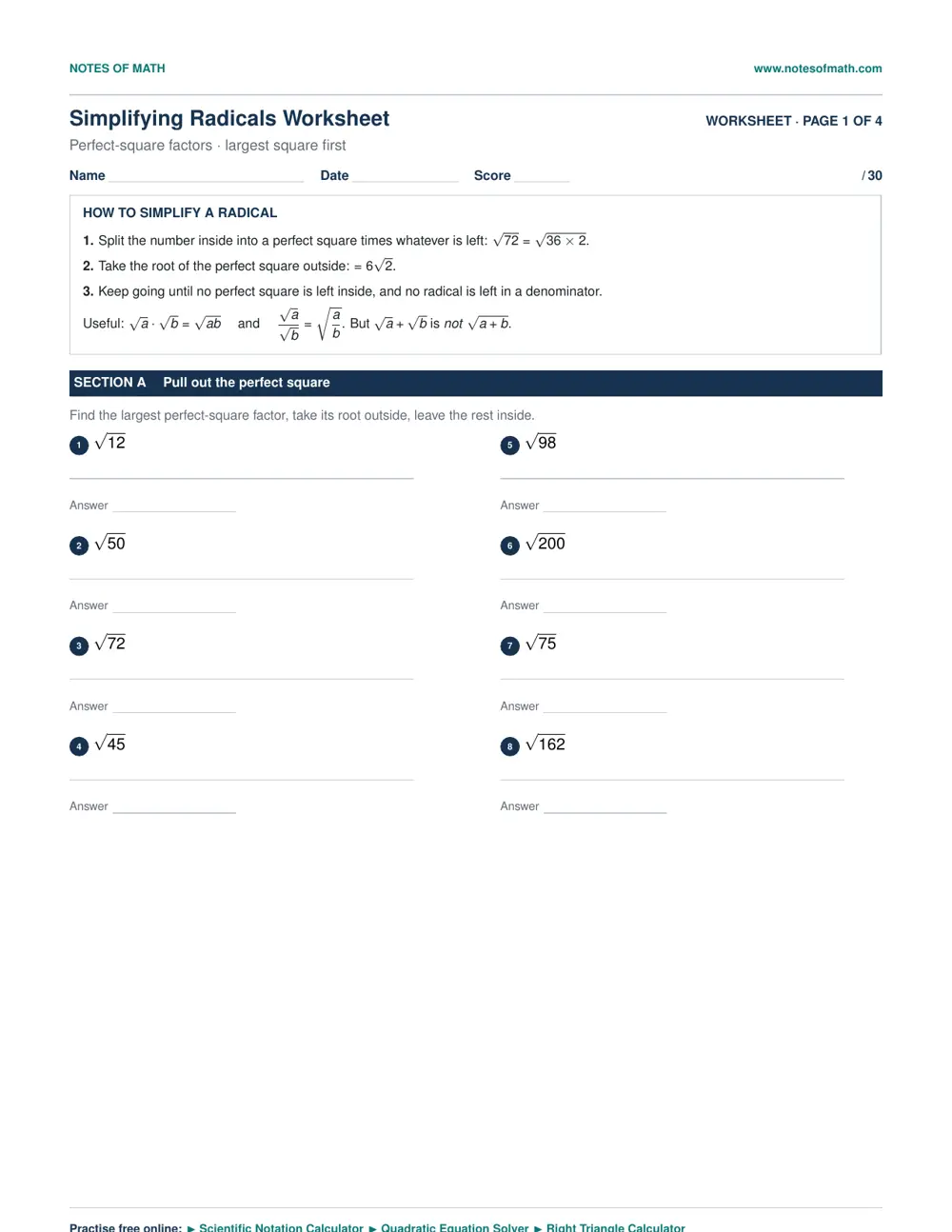
Practise simplifying radicals on one free printable worksheet. It starts with pulling perfect squares out of a number, adds variables, then covers multiplying, dividing, rationalising a denominator and combining like radicals.
Download the worksheet
Four pages of practice and a three-page worked answer key, with the perfect-square factor shown for each question.
What is on the worksheet
- Section A — perfect-square factors (8 questions). Numbers only, from √12 up to √200.
- Section B — radicals with variables (6 questions). Even powers come out whole; odd powers leave one factor behind.
- Section C — multiplying radicals (6 questions). Multiply first, then simplify what you get.
- Section D — dividing and rationalising (6 questions). Clearing a radical out of a denominator.
- Section E — adding and subtracting like radicals (4 questions). Terms that look different are often alike once simplified.
- Section F — explain your reasoning (2 questions). Why √a + √b is not √(a+b), and why denominators get rationalised.
- Answer key (3 pages). Each simplification with its factorisation.
How to simplify a radical
Simplifying means pulling out everything that comes out, and leaving no radical in a denominator.
- Split the number inside into a perfect square times whatever is left: √72 = √(36 × 2).
- Take the root of the perfect square outside: = 6√2.
- Repeat until no perfect square is left inside.
- Rationalise any denominator by multiplying top and bottom by the radical.
Worked example: √72. The largest perfect square dividing 72 is 36, so √72 = √36 × √2 = 6√2. Using 4 instead still works, it just takes an extra round: 2√18 = 2 × 3√2 = 6√2.
Radicals with variables
Assuming every variable is positive, pairs come out of the radical and singles stay in. √(x⁴) = x², because x⁴ is (x²)². √(x⁵) = x²√x, because x⁵ is x⁴ × x.
A quick shortcut: halve the exponent to get what comes out, and whatever is left over stays inside. An even exponent leaves nothing behind; an odd one leaves one.
Rationalising the denominator
Convention says a final answer should carry no radical in its denominator. Multiply the top and bottom by that radical: 1 ÷ √3 becomes √3 ÷ 3.
The value does not change — both are about 0.577 — only the form. A rational denominator makes an expression easier to compare, combine with other fractions, and estimate by hand.
The mistake to watch for
Treating the radical as if it distributes over addition. It distributes over multiplication and division only. Test it: √(9 + 16) = √25 = 5, but √9 + √16 = 3 + 4 = 7.
Frequently asked questions
What does it mean to simplify a radical?
To remove every perfect-square factor from inside the radical, and to leave no radical in a denominator. √50 simplifies to 5√2.
Can you add √2 and √3?
Not into a single radical. Only like radicals — ones with the same number inside — combine. √2 + √3 stays as it is, but 3√5 + 4√5 = 7√5.
Why do denominators have to be rationalised?
It is a convention, not a mathematical necessity. Both forms are equal, but a rational denominator is easier to compare and combine, which is why answers are expected in that form.
Do I need absolute value signs?
Only when a variable could be negative. This worksheet states that every variable is positive, so they are not needed here.