
Completing the Square Worksheet
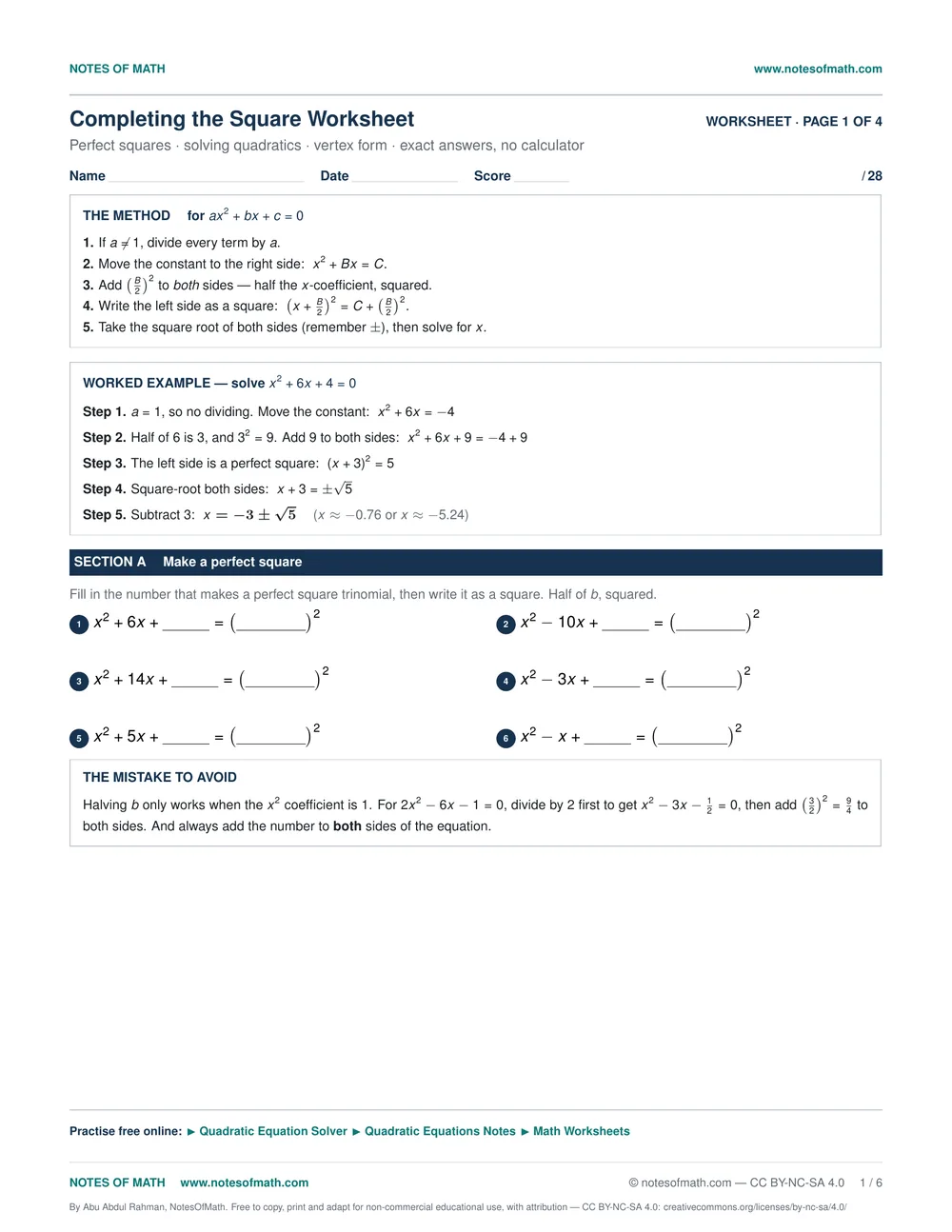
Practise completing the square on one free printable worksheet. It starts with building perfect square trinomials, then solves equations with whole-number, irrational and complex answers, handles a leading coefficient other than 1, and finishes by writing parabolas in vertex form.
Download the worksheet
Four pages of practice and a two-page worked answer key, with the completed square shown for every equation.
What is on the worksheet
- Section A — make a perfect square (6 questions). Find the number that completes x² + 6x + ___ and write it as (x + 3)².
- Section B — whole-number roots (6 questions). Equations that factor, solved by completing the square anyway so the method is secure before the numbers get harder.
- Section C — irrational roots (6 questions). Answers left in exact form with simplified radicals, including odd middle terms and equations that need rearranging first.
- Section D — a not equal to 1, and complex roots (6 questions). Divide by the leading coefficient first. Two of these have a negative number on the right, so the roots are complex.
- Section E — vertex form (4 questions). Write y = ax² + bx + c as y = a(x − h)² + k and state the vertex.
- Answer key (2 pages). Every equation with its working: the added number, the completed square and the roots.
How to complete the square
Completing the square rewrites a quadratic so that one side is a perfect square. Once it is, a square root finishes the job. For an equation ax² + bx + c = 0:
- Make the x² coefficient 1. If a is not 1, divide every term by a.
- Move the constant to the right: x² + bx = −c.
- Add (b ÷ 2)² to both sides. Half of the x-coefficient, squared.
- Write the left side as a square: (x + b/2)² = a number.
- Take the square root of both sides (use ±), then subtract b/2.
Worked example: solve x² + 6x + 4 = 0. Move the 4: x² + 6x = −4. Half of 6 is 3 and 3² = 9, so add 9 to both sides: x² + 6x + 9 = 5. The left side is (x + 3)², so (x + 3)² = 5. Take the square root: x + 3 = ±√5. Subtract 3: x = −3 ± √5, which is about −0.76 or −5.24.
Completing the square when a is not 1
The halving rule only works when the x² coefficient is 1, so divide the whole equation by a before you do anything else. For 2x² − 6x − 1 = 0, divide by 2 to get x² − 3x − ½ = 0, then move the constant: x² − 3x = ½. Half of 3 is 3/2 and (3/2)² = 9/4, so add 9/4 to both sides: (x − 3/2)² = 11/4. Then x − 3/2 = ±√11/2, so x = (3 ± √11)/2.
Keeping the fractions exact, rather than switching to decimals, is what lets the answer come out as a clean radical.
When the roots are complex
If the number on the right of (x + h)² = k is negative, there is no real square root, and the equation has complex roots. For x² + 4x + 13 = 0, completing the square gives (x + 2)² = −9, so x + 2 = ±3i and x = −2 ± 3i. Section D includes two of these. A negative number on the right is the sign to look for, and it is the same thing as a negative discriminant in the quadratic formula.
Completing the square to find the vertex
The same method rewrites y = ax² + bx + c as y = a(x − h)² + k, where the vertex is (h, k). For y = x² − 4x + 1, add and subtract 4: y = (x² − 4x + 4) − 4 + 1 = (x − 2)² − 3, so the vertex is (2, −3). When a is not 1, factor it out of the x terms first: y = 3x² + 6x + 1 = 3(x² + 2x) + 1 = 3(x + 1)² − 2, with vertex (−1, −2). Section E practises exactly this.
The mistake to watch for
Adding the number to one side only. Whatever you add to complete the square must be added to both sides, or the equation changes. The second slip is halving b before dividing by a: in 2x² − 6x − 1 = 0 the 6 is not halved until the whole equation has been divided by 2.
Frequently asked questions
What does completing the square mean?
It means adding the right number to x² + bx so the expression becomes a perfect square: x² + bx + (b/2)² = (x + b/2)². The same number is added to the other side of an equation so that both sides stay equal.
When should I use completing the square instead of factoring or the quadratic formula?
Use factoring when the numbers allow it, because it is fastest. Completing the square always works, and it is the method that rewrites a quadratic in vertex form. The quadratic formula is itself what you get by completing the square on ax² + bx + c = 0, so the two methods give the same answers.
How do I complete the square when the leading coefficient is not 1?
Divide every term by the leading coefficient first. Then follow the usual steps with the new, smaller coefficient. For vertex form, factor the leading coefficient out of the x² and x terms instead.
What if the number on the right is negative?
The equation has no real roots. In a course that includes complex numbers, take the square root of the negative number using i, so √(−9) = 3i. Section D has two equations like this.
Does the worksheet have an answer key?
Yes. The last two pages show every equation with its working and final answer, so students can find exactly where a mistake happened.