
Quadratic Formula Worksheet
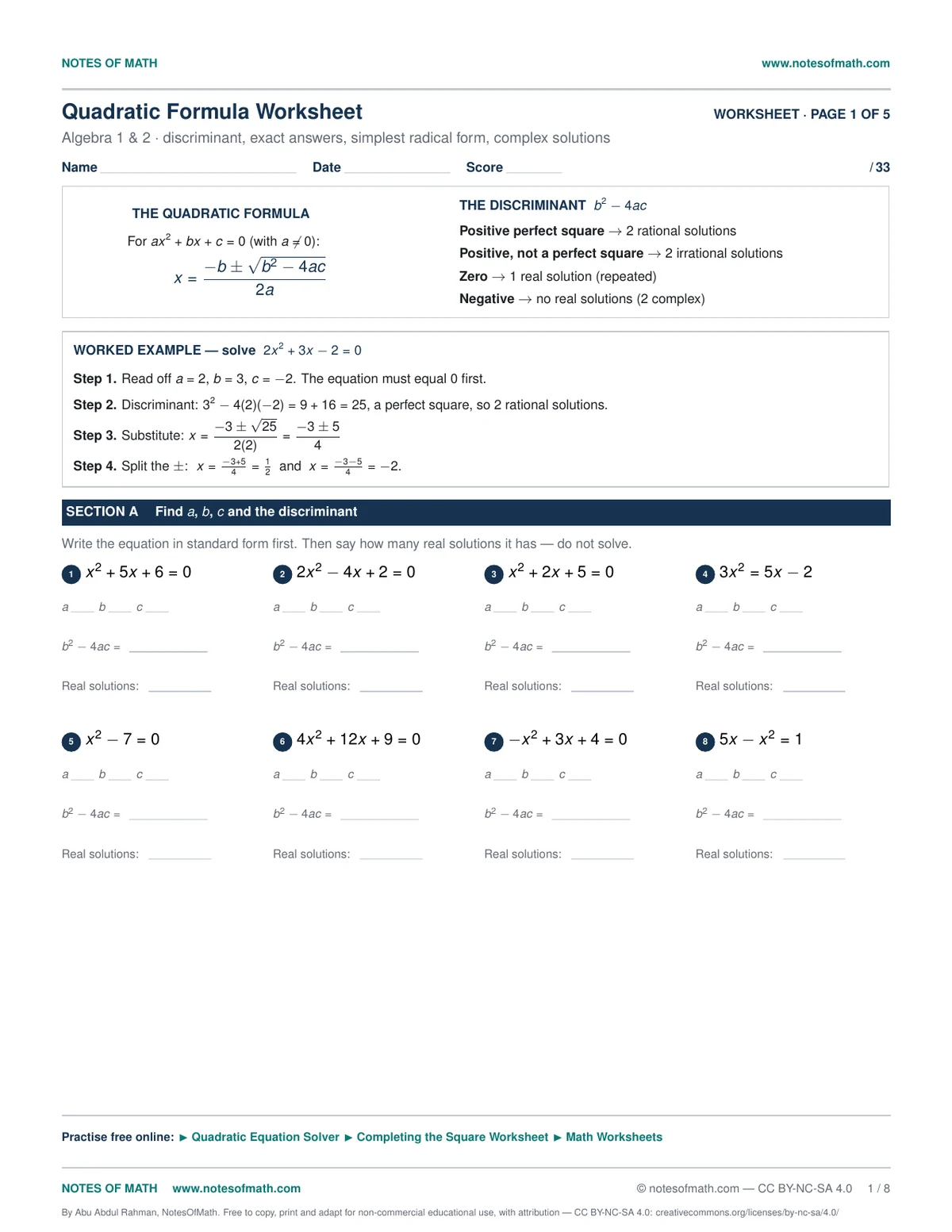
A free printable quadratic formula worksheet for Algebra 1 and Algebra 2. It starts with finding a, b, c and the discriminant, then solving with rational answers, answers in simplest radical form, equations with no real solutions (with the complex answers for Algebra 2), equations that need rearranging first, and word problems. The answer key shows the substitution, the discriminant and every simplification step.
Download the quadratic formula worksheet
Five pages of practice and a three-page answer key with the working for every equation.
What is on the worksheet
- Section A — \(a\), \(b\), \(c\) and the discriminant (8 questions). Rewrite in standard form, find \(b^2 – 4ac\) and say how many real solutions there are, without solving.
- Section B — rational answers (8 equations). The discriminant is a perfect square, so the answers are whole numbers or fractions; includes \(b = 0\) and \(c = 0\) cases.
- Section C — simplest radical form (6 equations). Simplify the square root, then divide out the common factor, as in \(\dfrac{2 \pm \sqrt{10}}{2}\).
- Section D — negative discriminant (4 equations). No real solutions; Algebra 2 students also write the complex answers, such as \(-1 \pm 2i\).
- Section E — standard form first (4 equations). Equations like \(2x^2 + 3 = 7x\) and \(x(x + 6) = 2\) that must be rearranged before \(a\), \(b\) and \(c\) can be read.
- Section F — word problems (3 problems). A ball thrown from a roof, a rectangle’s area and a rocket’s flight, with the negative answers rejected.
- Answer key (3 pages). \(a\), \(b\), \(c\), the substituted formula, the discriminant and every simplification step.
The quadratic formula
For any quadratic equation written as \(ax^2 + bx + c = 0\), with \(a \ne 0\), the solutions are
\[ x = \frac{-b \pm \sqrt{b^2 – 4ac}}{2a} \]
The \(\pm\) gives two answers: one with \(+\) and one with \(-\).
- Write the equation in standard form, with \(0\) on one side. \(3x^2 = 5x – 2\) becomes \(3x^2 – 5x + 2 = 0\).
- Read off \(a\), \(b\) and \(c\), keeping their signs.
- Find the discriminant \(b^2 – 4ac\).
- Substitute into the formula and simplify, then split the \(\pm\) into two answers.
Worked example: solve \(2x^2 + 3x – 2 = 0\). Here \(a = 2\), \(b = 3\), \(c = -2\). The discriminant is \(3^2 – 4(2)(-2) = 9 + 16 = 25\). So \(x = \dfrac{-3 \pm \sqrt{25}}{4} = \dfrac{-3 \pm 5}{4}\), which gives \(x = \tfrac12\) and \(x = -2\).
The discriminant: how many solutions?
| Discriminant \(b^2 – 4ac\) | Solutions | Example |
|---|---|---|
| Positive perfect square | 2 rational | \(x^2 + 5x + 6 = 0\) \((D = 1)\) |
| Positive, not a perfect square | 2 irrational | \(x^2 – 7 = 0\) \((D = 28)\) |
| Zero | 1 repeated | \(4x^2 + 12x + 9 = 0\) \((D = 0)\) |
| Negative | No real solutions (2 complex) | \(x^2 + 2x + 5 = 0\) \((D = -16)\) |
Answers in simplest radical form
When the discriminant is not a perfect square, the answer keeps a square root. Simplify the root by taking out square factors, then divide every term on top by the bottom, or divide out a common factor.
Worked example: \(x^2 – 2x – 2 = 0\). \(x = \dfrac{2 \pm \sqrt{4 + 8}}{2} = \dfrac{2 \pm \sqrt{12}}{2}\). Since \(\sqrt{12} = 2\sqrt3\), this is \(\dfrac{2 \pm 2\sqrt3}{2} = 1 \pm \sqrt3\).
Quadratic formula word problems
Height and area problems lead to quadratics. A ball thrown up from an 80 ft roof has height \(h = -16t^2 + 64t + 80\). It hits the ground when \(h = 0\), and the formula gives \(t = 5\) or \(t = -1\). Time cannot be negative, so the ball lands after 5 seconds. Always check whether each answer makes sense in the problem.
The mistakes to watch for
Reading \(a\), \(b\) and \(c\) before the equation equals \(0\). Losing the sign of \(b\): if \(b = -3\), then \(-b = 3\). Writing \(-3^2\) instead of \((-3)^2 = 9\). Dividing only the first term by \(2a\). And forgetting the second answer from the \(\pm\).
Frequently asked questions
What is the quadratic formula?
\(x = \dfrac{-b \pm \sqrt{b^2 – 4ac}}{2a}\). It solves every quadratic equation \(ax^2 + bx + c = 0\), including the ones that cannot be factored.
What does the discriminant tell you?
The number and type of solutions. Positive means two real solutions (rational if it is a perfect square), zero means one repeated solution, and negative means no real solutions.
When should you use the quadratic formula instead of factoring?
Whenever factoring is not quick. Factoring is fastest when the numbers are small and the discriminant is a perfect square; the quadratic formula always works.
What if the discriminant is negative?
In Algebra 1, the equation has no real solutions. In Algebra 2, write the square root of the negative number with \(i = \sqrt{-1}\) to get two complex solutions, such as \(x = -1 \pm 2i\).
Does the worksheet have an answer key?
Yes. Three pages show \(a\), \(b\), \(c\), the substituted formula, the discriminant and the simplified answers. Every answer was checked by computer in the original equation before the PDF was made.