
Multiplying Polynomials Worksheet
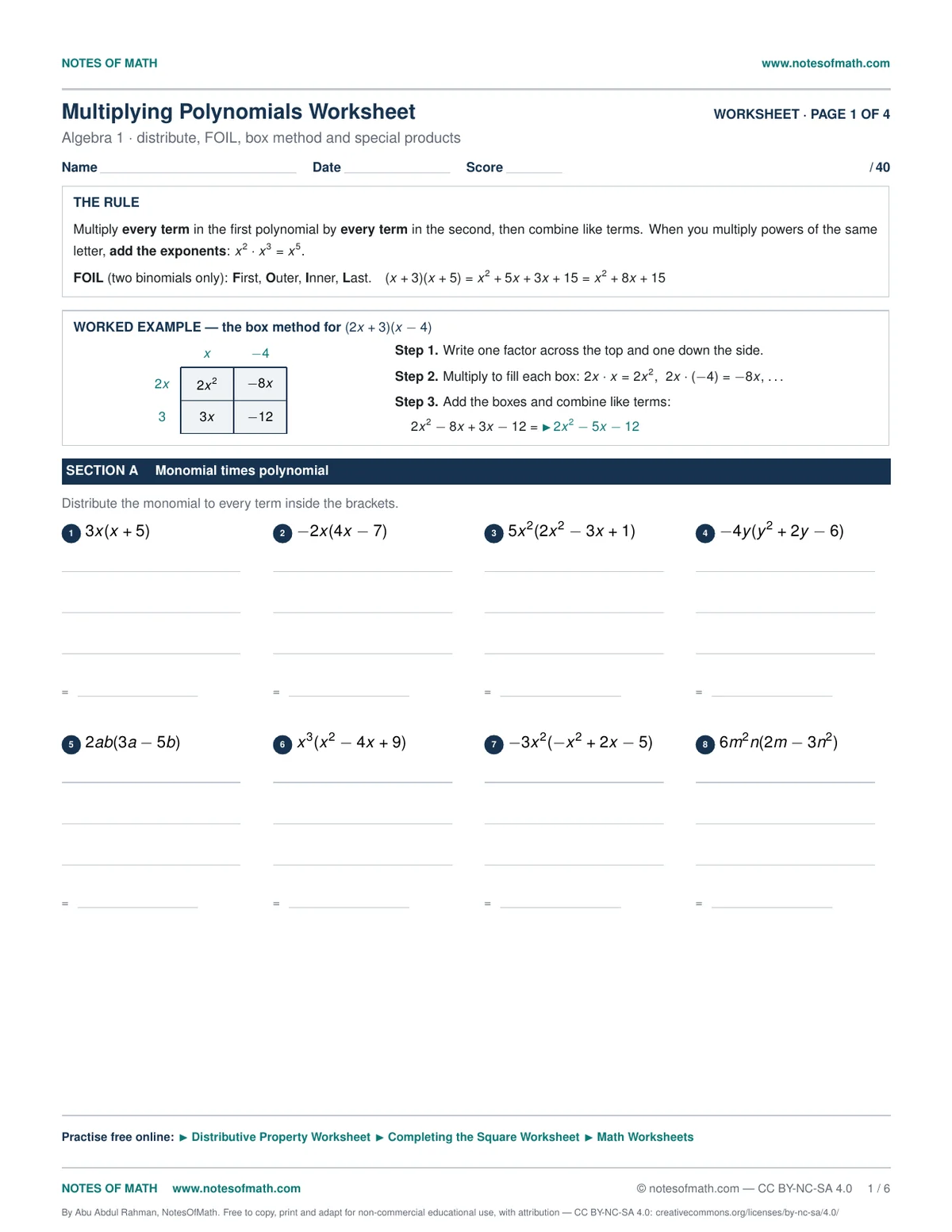
A free printable multiplying polynomials worksheet for Algebra 1, from a monomial times a polynomial up to two trinomials and three factors. It covers multiplying binomials with FOIL and the box method, the special products, and area and volume word problems. The answer key writes out every product before like terms are combined, so students can find the exact step that went wrong.
Download the worksheet
Four pages of practice and a two-page answer key that shows every product before the like terms are combined.
What is on the worksheet
- Section A — monomial times polynomial (8 questions). \(3x(x + 5)\), \(-2x(4x – 7)\), \(5x^2(2x^2 – 3x + 1)\), and two-variable terms like \(2ab(3a – 5b)\).
- Section B — binomial times binomial (10 questions). FOIL or box method, from \((x + 3)(x + 5)\) to \((5x + 2)(3x – 4)\), plus two-variable pairs like \((x + 2y)(x – 3y)\).
- Section C — special products (8 questions). Squares of binomials such as \((3x + 2)^2\) and differences of squares such as \((4x – 3)(4x + 3)\).
- Section D — binomial times trinomial (6 questions). Six products, then combine, including \((x – 4)(x^2 + 4x + 16)\), where almost everything cancels.
- Section E — longer products (4 questions). Two trinomials and three factors, such as \((x + 1)(x + 2)(x + 3)\) and \((x – 2)^3\).
- Section F — area and volume (4 questions). Write the product for a rectangle, a square garden, a box and a picture frame border.
- Answer key (2 pages). Every product listed before combining, so mistakes are easy to trace.
How to multiply polynomials
The rule is the distributive property used again and again: multiply every term in the first polynomial by every term in the second, then combine like terms. When the same letter is multiplied, add the exponents, so \(x^2 \cdot x^3 = x^5\).
- Multiply each term of the first polynomial by each term of the second. A binomial times a trinomial gives \(2 \times 3 = 6\) products.
- Write every product down before simplifying. Skipping this step is where most errors come from.
- Combine like terms (same letter, same power) and write the answer from the highest power down.
Worked example: \((x + 2)(x^2 + 3x – 4)\). The \(x\) times each term gives \(x^3 + 3x^2 – 4x\). The \(2\) times each term gives \(2x^2 + 6x – 8\). Combine: \(x^3 + 5x^2 + 2x – 8\).
Multiplying binomials: FOIL and the box method
For two binomials, FOIL is a checklist for the four products: First, Outer, Inner, Last. For \((x + 3)(x + 5)\):
\[ (x + 3)(x + 5) = \underbrace{x^2}_{\text{F}} + \underbrace{5x}_{\text{O}} + \underbrace{3x}_{\text{I}} + \underbrace{15}_{\text{L}} = x^2 + 8x + 15 \]
The box method does the same job in a grid. Write one factor across the top and the other down the side, fill each box with the product, then add the boxes. Signs are easier to keep track of, and it works for trinomials too, where FOIL does not.
Worked example: \((2x + 3)(x – 4)\). The boxes are \(2x^2\), \(-8x\), \(3x\) and \(-12\). Add them: \(2x^2 – 8x + 3x – 12 = 2x^2 – 5x – 12\).
Special products
| Pattern | Rule | Example |
|---|---|---|
| Square of a sum | \((a + b)^2 = a^2 + 2ab + b^2\) | \((x + 6)^2 = x^2 + 12x + 36\) |
| Square of a difference | \((a – b)^2 = a^2 – 2ab + b^2\) | \((x – 5)^2 = x^2 – 10x + 25\) |
| Difference of squares | \((a + b)(a – b) = a^2 – b^2\) | \((x + 9)(x – 9) = x^2 – 81\) |
Knowing these patterns saves time, and it is the start of factoring: reading them backwards turns \(x^2 + 12x + 36\) into \((x + 6)^2\).
The mistakes to watch for
Squaring each term separately: \((x + 6)^2\) is \(x^2 + 12x + 36\), not \(x^2 + 36\). Missing the outer and inner products of FOIL, so the middle term disappears. Multiplying exponents instead of adding them: \(x^2 \cdot x^3\) is \(x^5\), not \(x^6\). Dropping a negative sign in one of the products. And stopping before combining like terms.
Frequently asked questions
How do you multiply polynomials?
Multiply every term in the first polynomial by every term in the second, write all the products, then combine like terms. For \((x + 2)(x – 5)\): \(x^2 – 5x + 2x – 10 = x^2 – 3x – 10\).
What is the FOIL method?
A way to remember the four products when multiplying two binomials: First, Outer, Inner, Last. It only works for two binomials; for longer polynomials, use the box method or distribute term by term.
What is the box method for multiplying polynomials?
A grid with one factor across the top and the other down the side. Each box holds the product of its row and column, and the answer is the sum of the boxes after combining like terms.
How many terms do you get when you multiply a binomial by a trinomial?
Six products before combining. After like terms are combined there are often fewer; \((x – 4)(x^2 + 4x + 16)\) shrinks all the way to \(x^3 – 64\).
Does the worksheet have an answer key?
Yes. The last two pages show every product before combining and the final answer. All answers were checked by computer before the PDF was made.