
Distributive Property Worksheet
Practise the distributive property on one free printable worksheet, written for Algebra 1. It starts with expanding brackets, moves on to the distributive property with combining like terms, then solving equations with the distributive property, and finishes with factoring it in reverse and a few word problems. Worked answer key included.
Download the worksheet
Four pages of practice and a two-page answer key, with the expanded line shown for every expression and the working shown for every equation.
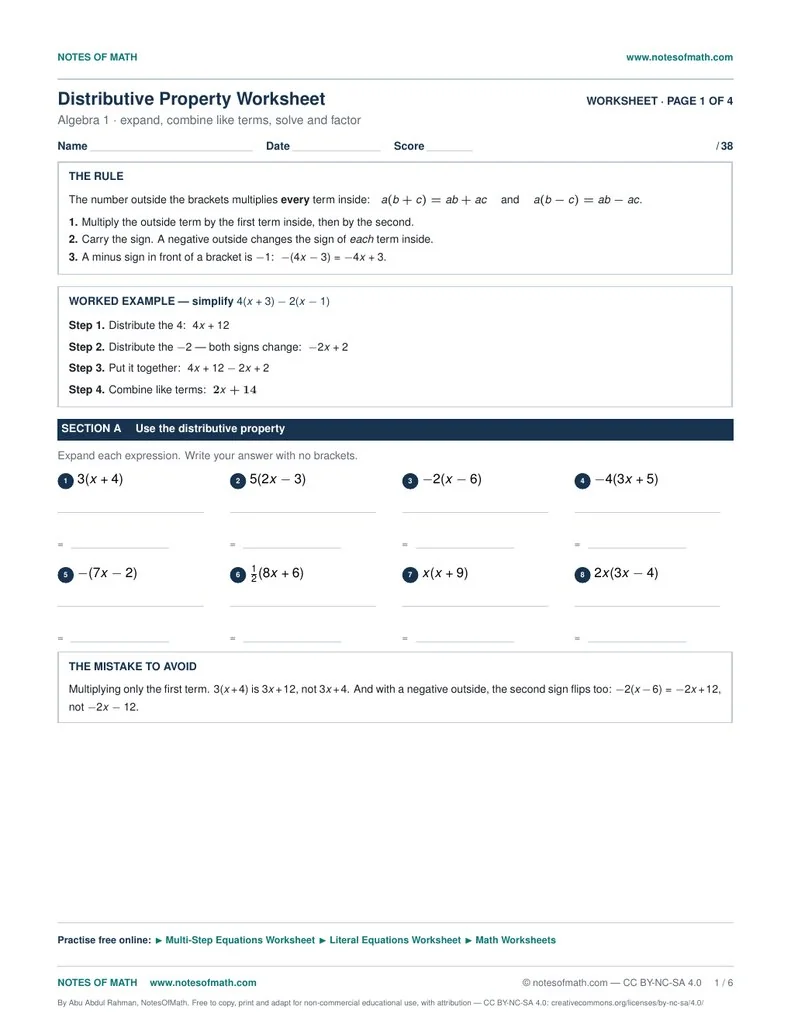
What is on the worksheet
- Section A — use the distributive property (8 questions). Expand the brackets: 3(x + 4), a negative outside like −2(x − 6), a minus sign alone like −(7x − 2), a fraction outside, and x outside, which gives an x² term.
- Section B — distributive property and combining like terms (8 questions). Expand, then collect the x terms and the number terms: 4(x + 3) − 2(x − 1), 2(3x + 1) + 3(x − 4) and six more.
- Section C — solving equations with the distributive property (12 questions). One bracket, two brackets, brackets on both sides, a fraction outside, and two equations that do not have a single answer.
- Section D — factoring with the distributive property (6 questions). Take out the greatest common factor: 6x + 12, 12y + 18z, 8x² + 4x, −4x − 20.
- Section E — word problems (4 questions). Write the equation with brackets, distribute, solve and answer in a sentence.
- Answer key (2 pages). Every expression with its expanded line and every equation with its working, so a student can see which step went wrong.
What is the distributive property?
The distributive property says that the number outside a bracket multiplies every term inside it: a(b + c) = ab + ac, and in the same way a(b − c) = ab − ac. So 3(x + 4) = 3x + 12, because the 3 multiplies the x and the 4.
- Multiply the outside term by the first term inside, then by the second.
- Carry the sign. A negative outside changes the sign of each term inside: −2(x − 6) = −2x + 12.
- Read a minus in front of a bracket as −1. −(7x − 2) = −7x + 2.
Distributive property and combining like terms
Most Algebra 1 expressions need both steps: remove the brackets with the distributive property, then combine like terms. Like terms have the same letter to the same power, so 4x and −2x combine, but 3x and 3x² do not, and neither do 3x and 3.
Worked example: simplify 4(x + 3) − 2(x − 1). Distribute the 4: 4x + 12. Distribute the −2, and both signs change: −2x + 2. Put it together: 4x + 12 − 2x + 2. Combine the x terms and the numbers: 2x + 14.
Sometimes the x terms cancel completely. In −3(2x − 4) + 6x − 5 the −6x and +6x add to zero and the answer is just 7. That is a correct, finished answer, and Section B has one like it.
Solving equations with the distributive property
To solve an equation with brackets, use the distributive property first and solve second. Once the brackets are gone it is an ordinary two-step equation.
- Distribute on each side to remove the brackets.
- Combine like terms on each side.
- Move the x terms to one side and the numbers to the other.
- Divide by the number in front of x, then check by substituting back in.
Worked example: solve 4(2x + 1) − 3(x − 2) = 25. Distribute: 8x + 4 − 3x + 6 = 25. Combine like terms: 5x + 10 = 25. Subtract 10: 5x = 15. Divide by 5: x = 3. Check: 4(7) − 3(1) = 28 − 3 = 25. ✓
Two equations in Section C do not have a single answer. If the x terms cancel and what is left is true, such as 6 = 6, every number is a solution. If what is left is false, such as −3 = 5, there is no solution. 2(x + 3) = 2x + 6 is the first kind; 3(x − 1) = 3x + 5 is the second.
Factoring with the distributive property
Factoring is the distributive property run backwards. Instead of multiplying a factor in, you find the greatest common factor of every term and take it out: 6x + 12 = 6(x + 2), and 8x² + 4x = 4x(2x + 1). To check, distribute your answer and you should get the original back. If the bracket that is left still has a common factor, there is more to take out.
The mistakes to watch for
Multiplying only the first term: 3(x + 4) is 3x + 12, not 3x + 4. Losing the second sign when the outside number is negative: −2(x − 6) is −2x + 12, because a negative times a negative is positive. Forgetting that a minus in front of a bracket changes every sign inside: 6 − (3x − 2) is 6 − 3x + 2, not 6 − 3x − 2. And combining terms that are not alike, such as adding 3x and 3 to make 6x.
Frequently asked questions
What is the distributive property in algebra?
It is the rule a(b + c) = ab + ac: a number or term outside a bracket multiplies every term inside it. It works the same way with subtraction, a(b − c) = ab − ac.
How do you use the distributive property to solve an equation?
Distribute to remove the brackets, combine like terms on each side, move the x terms to one side and the numbers to the other, then divide. For 3(x + 4) = 27: 3x + 12 = 27, so 3x = 15 and x = 5.
Do you distribute before combining like terms?
Yes. Terms inside a bracket cannot be combined with terms outside it until the bracket is gone, so distribute first and combine second.
What grade is the distributive property taught in?
It is first met with numbers in grades 3 to 6, then used with variables in grades 6 and 7. This worksheet is the Algebra 1 version — expressions with variables, combining like terms, equations and factoring — which is usually grade 8 or 9.
Does the worksheet have an answer key?
Yes. The last two pages show the expanded line for every expression and the working for every equation. Every answer was checked by computer before the PDF was made.