
Literal Equations Worksheet
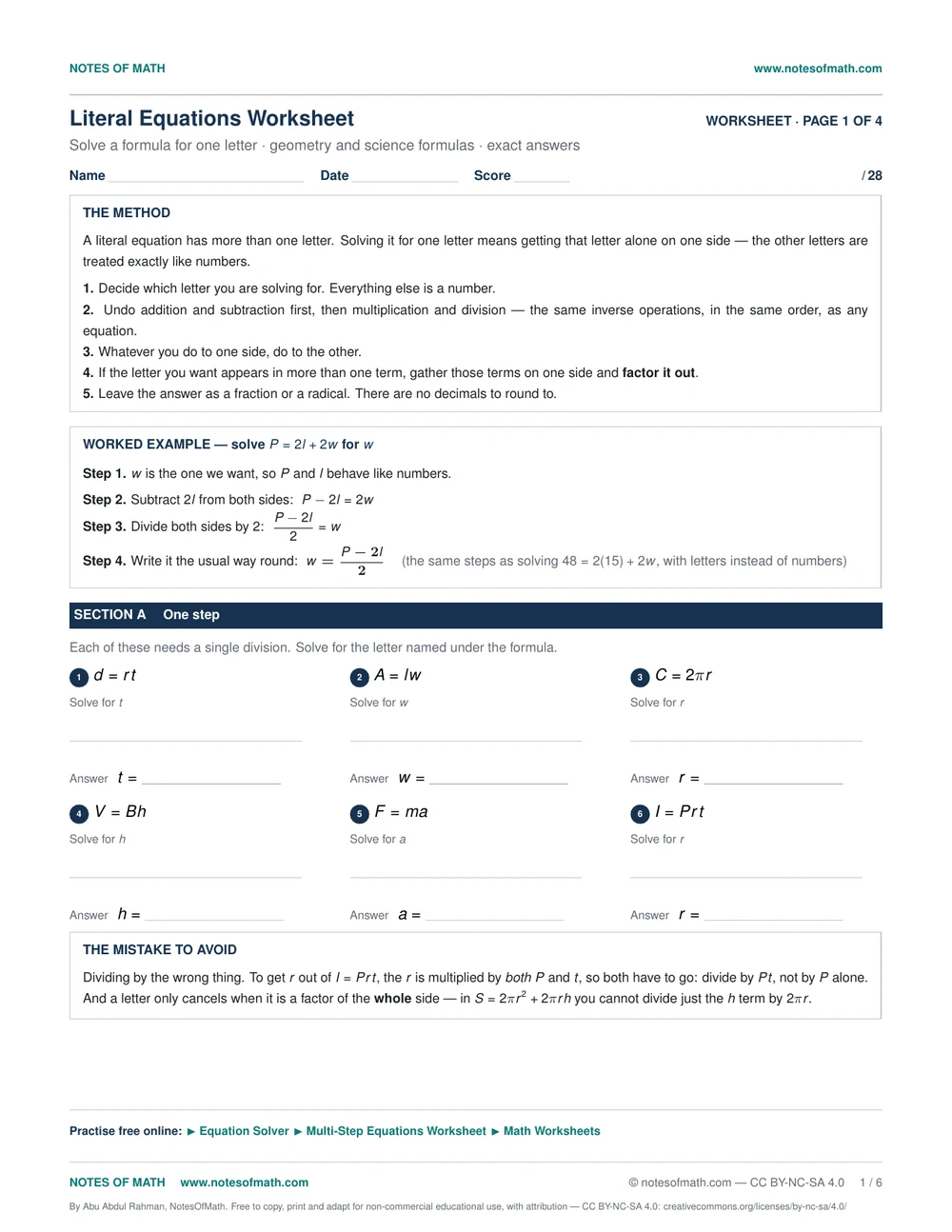
Solve a formula for any letter in it, on one free printable worksheet. It starts with one-step formulas like d = rt, moves through the two-step rearranging that Algebra 1 asks for, covers the real geometry and science formulas, and then does the part most worksheets skip: equations where the letter you want appears twice and has to be factored out. Answer key included.
Download the worksheet
Four pages of practice and a two-page worked answer key, with the working shown line by line for every formula.
What is on the worksheet
- Section A — one step (6 questions). One division each: d = rt for t, A = lw for w, C = 2πr for r, V = Bh for h, F = ma for a, I = Prt for r.
- Section B — two steps (6 questions). Undo the addition first, then the multiplication: y = mx + b for x, P = 2l + 2w for w, 3x + 4y = 12 for y, point-slope form for x.
- Section C — real formulas (6 questions). Trapezoid area for b₁, the Celsius–Fahrenheit conversion for F, cylinder volume and surface area for h, Pythagoras for b, kinetic energy for v. Two of them end in a square root.
- Section D — gather and factor (6 questions). The letter you want appears twice: ax = bx + c, S = rs + rt, ay + y = T, G = kp + 2ak, P = S − Sdt. Collect the terms, factor, divide.
- Section E — rearrange and substitute (4 questions). Rearrange the formula, then use the rearranged version with real numbers, which is what rearranging is for.
- Answer key (2 pages). Every question with its working, not just the final line, so a student can see which step went wrong.
How to solve a literal equation
A literal equation is one with more than one letter in it — a formula, usually. Solving it for one letter means getting that letter alone on one side. The one idea that makes it work: every other letter is treated exactly like a number. The steps are the same ones used on any equation.
- Decide which letter you want. Everything else behaves like a number from that point on.
- Undo addition and subtraction first, then multiplication and division — the same inverse operations, in the same order, as a numerical equation.
- Do the same thing to both sides, every time.
- If the letter appears in more than one term, gather those terms on one side and factor it out.
- Leave the answer as a fraction or a radical. There are no decimals to round to until numbers replace the letters.
Worked example: solve P = 2l + 2w for w. The w is the one we want, so P and l behave like numbers. Subtract 2l from both sides: P − 2l = 2w. Divide both sides by 2: (P − 2l) ÷ 2 = w. Written the usual way round, w = (P − 2l)/2. These are the same two steps as solving 48 = 2(15) + 2w, with letters in place of the numbers.
When the letter you want appears twice
This is the part most worksheets leave out and the part exams ask about. If the letter sits in two terms, you cannot divide it away one term at a time — it has to become a single term first, and factoring is what does that.
Solve ay = by + c for y. Gather the y terms on one side: ay − by = c. Factor y out: y(a − b) = c. Now y is in one term, so divide: y = c/(a − b). The same three moves handle S = rs + rt for r, which gives r = S/(s + t), and P = S − Sdt for S, which gives S = P/(1 − dt). Section D is six of these.
Rearranging a formula that ends in a square root
When the letter you want is squared, undo everything else first and take the square root last. For a² + b² = c², subtract a² to get b² = c² − a², then b = √(c² − a²). For kinetic energy K = ½mv², multiply by 2, divide by m, then v = √(2K/m).
Formulas like these describe lengths, speeds and masses, so only the positive root is kept. The root also stays over the whole expression: √(c² − a²) is not c − a, and no cancelling inside the root is allowed.
Where literal equations come up
Literal equations sit early in Algebra 1, usually right after multi-step equations, which puts them in grade 8 or grade 9 for most students. They come back in geometry whenever an area or volume formula has to be rearranged, in science for rate, density and energy formulas, and on the SAT and ACT, where a question gives a formula and asks for a different letter. The skill is the same every time, which is why it is worth drilling once properly.
The mistakes to watch for
Dividing by part of a product instead of all of it. To get r out of I = Prt, the r is multiplied by both P and t, so divide by Pt, not by P alone. The second slip is cancelling a letter that is not a factor of the whole side: in S = 2πr² + 2πrh you cannot divide only the h term by 2πr — subtract 2πr² first, then divide. The third is stopping too early in Section D and leaving the wanted letter on both sides of the answer, which means it has not been solved for at all.
Frequently asked questions
What is a literal equation?
An equation with more than one letter in it, where the letters stand for quantities rather than one unknown to find. Most formulas are literal equations: d = rt, A = lw, y = mx + b. Solving one means rewriting it so a chosen letter stands alone.
How is solving a literal equation different from a normal equation?
It is not, mechanically. The same inverse operations are used in the same order. The only difference is that the answer is an expression in the other letters rather than a number, so there is nothing to simplify to at the end.
What do I do when the letter I want is in two terms?
Gather those terms on one side, factor the letter out, then divide by the bracket. For ax = bx + c that gives x(a − b) = c and then x = c/(a − b). Dividing before factoring is the usual mistake.
What grade are literal equations taught in?
Usually Algebra 1, so grade 8 or grade 9, straight after multi-step equations. They reappear in geometry, in science classes and on standardised tests.
Does the worksheet have an answer key?
Yes. The last two pages show every question with its working, so a student can see which step went wrong rather than just that the answer differs.