
Multi-Step Equations Worksheet
Practise solving multi-step equations on one free printable worksheet. It moves from two-step equations through variables on both sides, then equations needing the distributive property or a cleared fraction, and finishes with four word problems.
Download the worksheet
Four pages of practice and a three-page worked answer key, with the intermediate equation shown for every question.
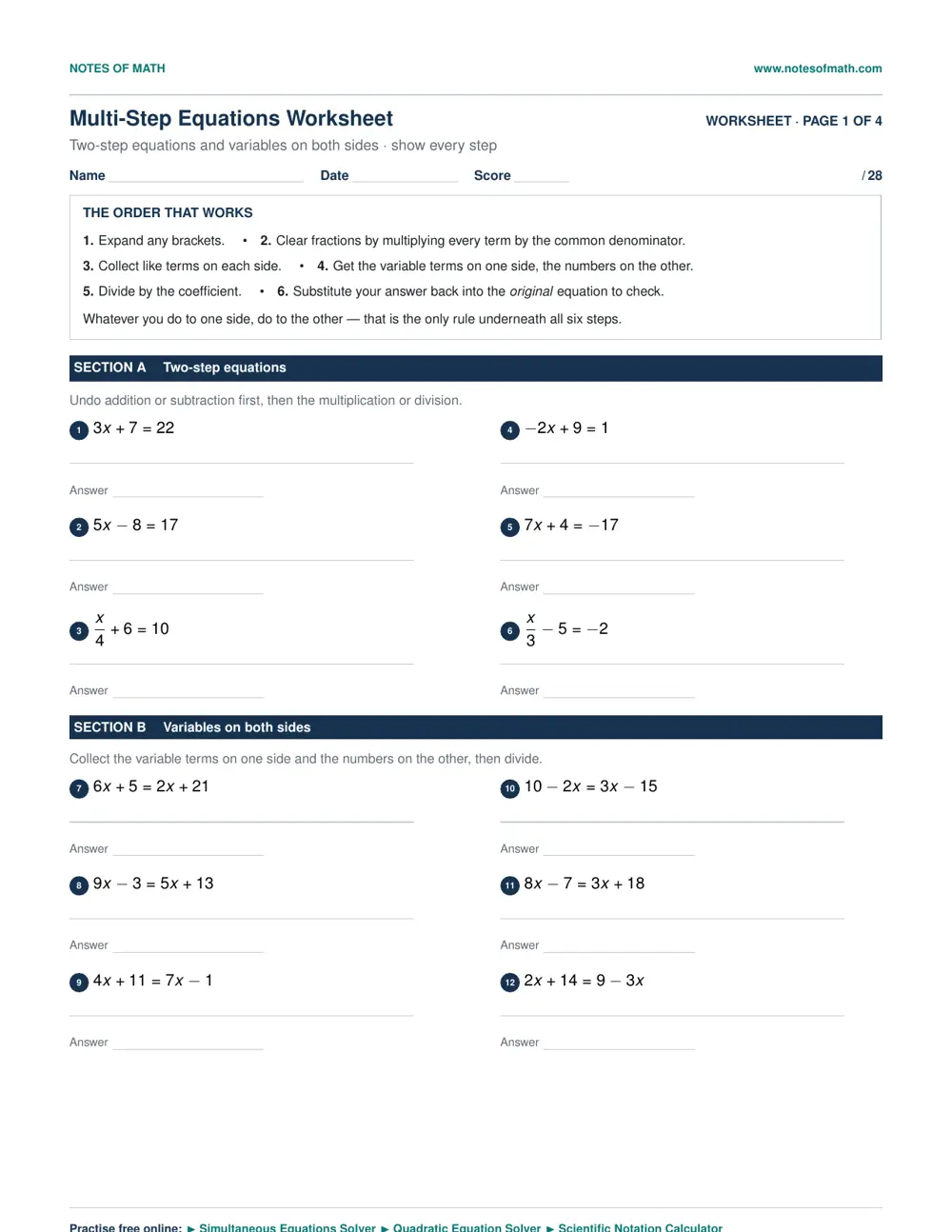
What is on the worksheet
- Section A — two-step equations (6 questions). Undo addition or subtraction first, then multiplication or division.
- Section B — variables on both sides (6 questions). Collect the variable terms on one side and the numbers on the other.
- Section C — the distributive property (6 questions). Expand the brackets before collecting terms, including a negative outside the brackets.
- Section D — fractional coefficients (4 questions). Clear the fractions by multiplying every term by the common denominator.
- Section E — word problems (4 questions). Consecutive integers, a phone bill, a rectangle’s dimensions, and a break-even comparison.
- Section F — explain your reasoning (2 questions). A classic distributive error, and how to check a solution properly.
- Answer key (3 pages). Each solution with its key intermediate step.
The order that works every time
Multi-step equations are not harder than two-step ones, they just have more layers. Peel them off in a fixed order and nothing gets missed.
- Expand any brackets. Multiply every term inside, not just the first.
- Clear fractions by multiplying every term by the common denominator.
- Collect like terms on each side separately.
- Move the variable terms to one side, the numbers to the other.
- Divide by the coefficient.
- Substitute back into the original equation to check.
Worked example: 3(x + 4) = 21. Expand first: 3x + 12 = 21. Subtract 12: 3x = 9. Divide by 3: x = 3. Check: 3(3 + 4) = 3 × 7 = 21. Correct.
Clearing fractions instead of working with them
An equation like x/2 + x/3 = 10 is easier if the fractions go first. Multiply every term by the common denominator — here 6 — to get 3x + 2x = 60, so 5x = 60 and x = 12.
The common slip is multiplying only the fraction terms and leaving the whole number alone. Every term on both sides has to be multiplied, or the equation stops being balanced.
Checking a solution without re-solving
Substitute your answer into the original equation and check both sides match. For x = 5 in 4x − 3 = 17: 4(5) − 3 = 17, and the right side is 17, so it is correct.
Substituting is a genuinely independent check. Re-solving the same way tends to repeat whatever slip you made the first time.
The mistake to watch for
Distributing to only the first term inside the brackets. 3(x + 2) is 3x + 6, never 3x + 2. The same applies with a negative outside: −2(x − 5) is −2x + 10, because the minus multiplies both terms.
Frequently asked questions
What counts as a multi-step equation?
Any equation needing more than one operation to isolate the variable. That covers two-step equations, equations with variables on both sides, and anything with brackets or fractions.
Do I always have to expand the brackets first?
Not always. If the whole bracket is multiplied by a number and the other side divides evenly, you can divide first instead. 3(x + 4) = 21 becomes x + 4 = 7 in one step. Expanding always works, though, so it is the safer default.
What if the variable disappears completely?
Then you have either an identity or a contradiction. If you end with something always true, such as 5 = 5, every number is a solution. If you end with something never true, such as 3 = 7, there is no solution.
Does the worksheet include answers?
Yes. The last three pages are a worked answer key for all 28 questions, showing the key intermediate equation as well as the final value.