
Adding Fractions with Unlike Denominators Worksheets
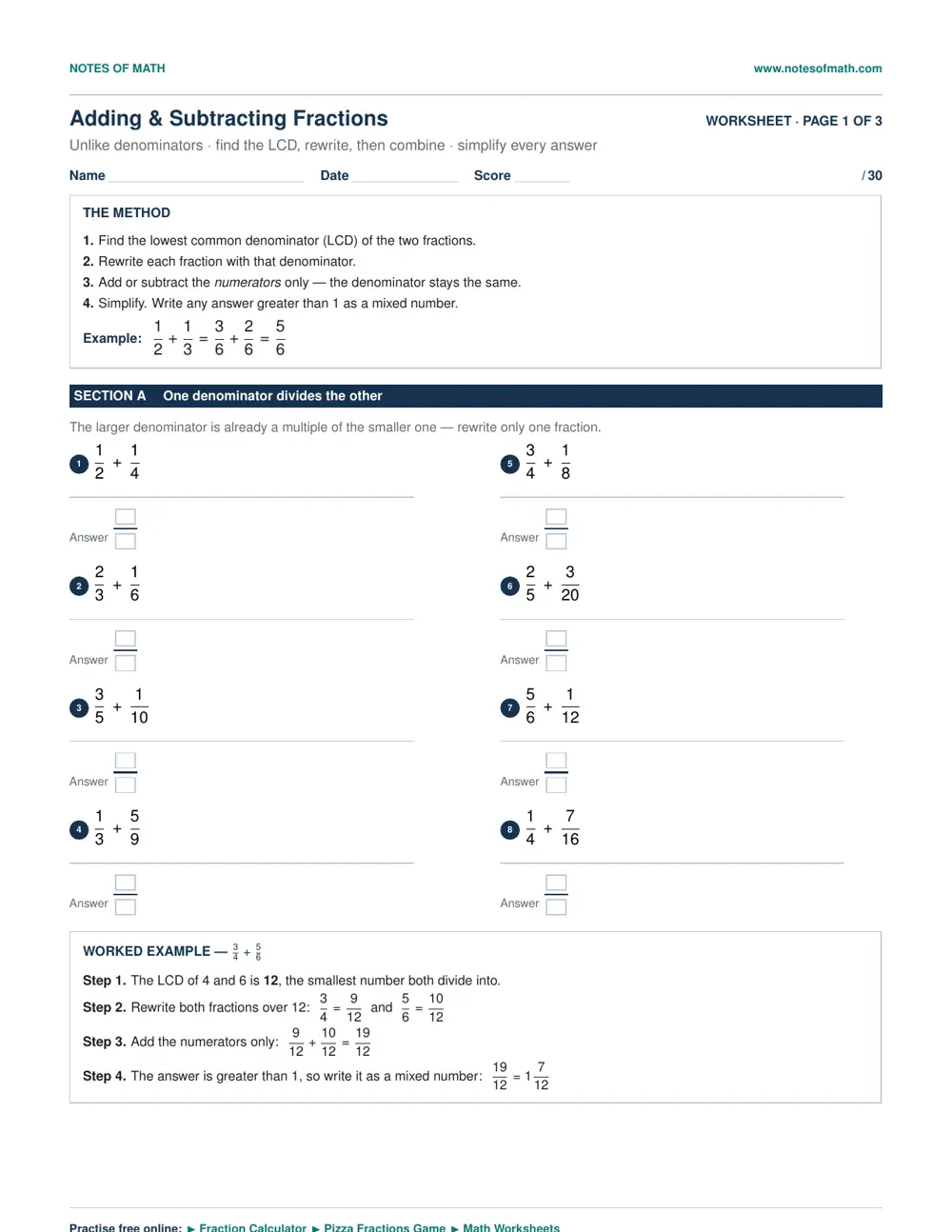
Practise adding and subtracting fractions with unlike denominators on one free printable worksheet. It starts where one denominator already divides the other, moves on to finding a lowest common denominator, then covers subtraction, mixed numbers and four word problems.
Download the worksheet
Three pages of practice and a two-page worked answer key. Designed to print clearly in black and white.
What is on the worksheet
- Section A — one denominator divides the other (8 questions). The larger denominator is already a multiple of the smaller, so only one fraction needs rewriting.
- Section B — find the lowest common denominator (8 questions). Neither denominator is a multiple of the other, so both must be rewritten.
- Section C — subtracting with unlike denominators (6 questions). The same method, applied to subtraction.
- Section D — mixed numbers (4 questions). Convert to improper fractions first, then combine.
- Section E — word problems (4 questions). Write the calculation, solve it, and label the answer with its units.
- Answer key (2 pages). Every question worked through: the rewritten fractions over the common denominator, the combined numerator, the simplified result.
How to add fractions with unlike denominators
Fractions can only be added when they share a denominator. When the denominators differ, rewrite both fractions over a common denominator first, then add the numerators.
- Find the lowest common denominator. The smallest number both denominators divide into evenly.
- Rewrite each fraction with that denominator, multiplying the numerator by the same factor you used on the denominator.
- Add the numerators only. The denominator does not change.
- Simplify, and write any answer greater than 1 as a mixed number.
Worked example: 3/4 + 5/6. The lowest common denominator of 4 and 6 is 12. 3/4 becomes 9/12 and 5/6 becomes 10/12, so the sum is 19/12, or 1 7/12.
Subtracting fractions with unlike denominators
Subtraction works exactly the same way. Find the lowest common denominator, rewrite both fractions over it, then subtract the second numerator from the first and simplify.
For example, 3/4 − 1/3 becomes 9/12 − 4/12, which is 5/12. Section C gives six questions on this, and the key shows the rewritten fractions for each.
Adding and subtracting mixed numbers
Convert each mixed number to an improper fraction before anything else, then find the common denominator and combine as usual. 1 1/2 + 2 1/3 becomes 3/2 + 7/3, which is 9/6 + 14/6 = 23/6, or 3 5/6.
Section D covers this, including two subtraction questions where the mixed numbers do not subtract neatly.
The mistake to watch for
The most common error is adding the denominators as well as the numerators. 1/2 + 1/3 is not 2/5. Rewriting both fractions over a common denominator first — 3/6 + 2/6 — makes it clear the answer is 5/6.
Frequently asked questions
What does “unlike denominators” mean?
It means the two fractions have different numbers on the bottom, such as 1/2 and 1/3. They cannot be added or subtracted until both are rewritten over the same denominator.
How do you find the lowest common denominator?
Find the smallest number both denominators divide into evenly. For 4 and 6 that is 12. If one denominator is already a multiple of the other, as with 3 and 9, the larger one is the LCD and only one fraction needs rewriting.
Does the worksheet include answers?
Yes. The last two pages contain a worked answer key for all 30 questions, showing each fraction rewritten over the common denominator rather than just the result.
Do I need a common denominator to multiply fractions?
No — that is only needed for addition and subtraction. To multiply, multiply the numerators together and the denominators together, then simplify.