🎮 Free Math Game for Kids
Pizza Fractions GameFeed the Hungry Monster
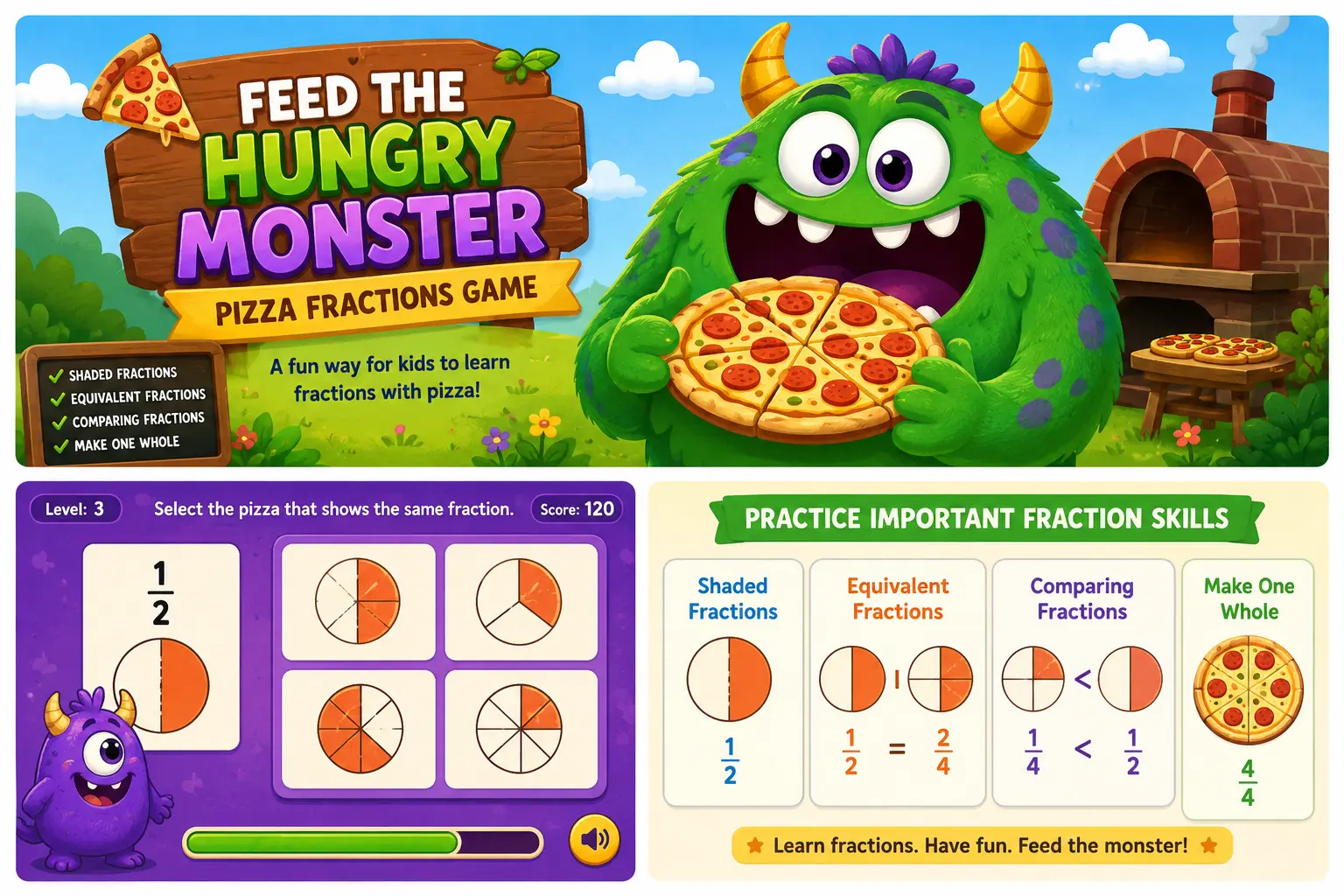
A hungry monster is waiting for pizza — and only your fraction skills can save it! Answer 10 challenges, feed each slice, and keep that big belly happy.
Play Now
Feed the Hungry Monster 🍕
Click Start Feeding to begin. Answer fraction questions, earn combo bonuses, and keep the monster full and happy!
Getting Started
How to Play
Five simple steps stand between you and a very full, very happy monster.
Click Start Feeding
Hit the big button to kick off the monster’s pizza feast. Sound effects are on — turn up the volume!
Read the Question
A fraction challenge appears. Some show pizza visuals. Some give you a fraction and ask you to find the right pizza.
Think, Then Tap
Count the slices carefully. Check all four answer choices before you pick — some look very similar on purpose!
Feed the Monster
Correct answers send a pizza slice flying to the monster. Build a streak of 3+ to trigger a Combo! bonus and faster feeding.
Finish All 10
Answer all 10 questions with 3 or fewer mistakes to win. Your score and best streak are shown at the end.
What You Learn
6 Fraction Skills in 1 Game
The game rotates through six distinct question types, arranged from easy to hard, so every round builds on the last. Tap any skill for a full walkthrough with worked examples.
🎮 What Is Feed the Hungry Monster?
Feed the Hungry Monster is an online pizza fractions game built around pizza slices. Students answer fraction questions, and each correct answer feeds a pizza slice to the monster. Get it right and the monster cheers. Get it wrong and it looks sad — and you lose one of your four chances.
The game runs for 10 questions per round. Questions grow harder as you go: the first three are easy, the next three are medium, and the final four push into more challenging territory. Correct answers earn 100 points each, with a +25 bonus for every answer in a streak. Hit a 3-answer streak and a Combo badge lights up.
🍕 Why Pizza Makes Fractions Click
Pizza is one of the most natural fraction models there is. A whole pizza can be cut into equal slices, and every slice becomes one part of the whole. When students see this, the abstract idea of a fraction becomes something they can count with their eyes.
A pizza is divided into 8 equal slices and 3 slices are selected.
The bottom number (8) = total equal slices · The top number (3) = slices selected
🔢 Numerator and Denominator
Every fraction has two parts. The numerator is on top and tells you how many parts are selected. The denominator is on the bottom and tells you the total number of equal parts.
Denominator = total equal parts (how many slices the pizza is cut into)
Numerator = selected or shaded parts (how many slices you have)
🗂️ The 6 Question Types (3 Difficulty Levels)
The game cycles through six types of fraction challenges across three difficulty levels. Each one builds a different skill — full explanations and worked examples for each are just below.
🍕 Shaded Fractions
A pizza shows some highlighted slices. Count all the slices, then count the shaded ones.
“What fraction of this pizza is shaded?”
👁️ Visual Choice
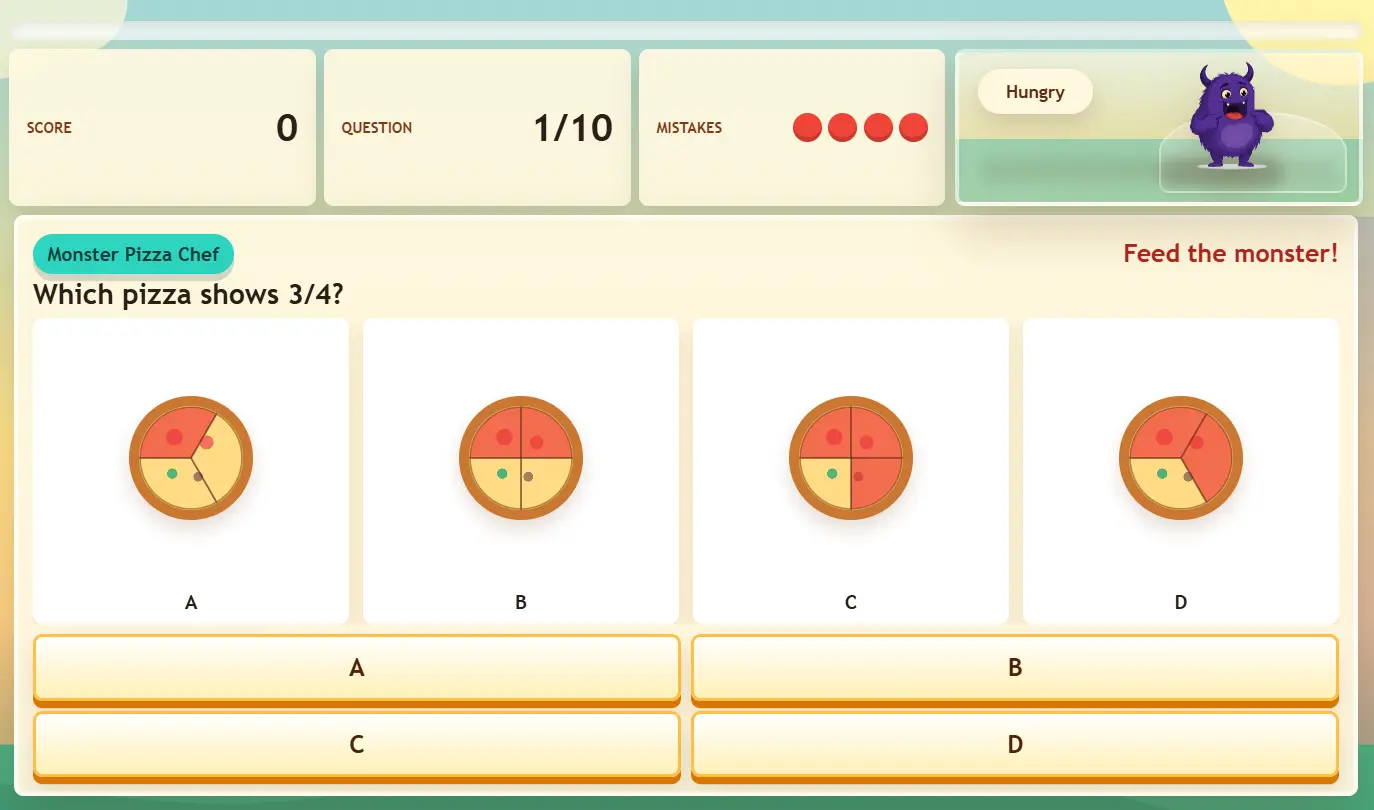
A fraction is shown as text. Find the pizza that matches it from four options.
“Which pizza shows 3/4?”
⚖️ Equivalent Fractions
Two fractions can look different but show the same amount.
“Which fraction equals 1/2?”
🔢 Comparing Fractions
Decide which fraction is larger, or if they are equal — three possible answers.
“Which fraction is larger: 1/3 or 2/3?”
🧩 Making One Whole
Part of the pizza is already there. How much more makes 4/4?
“This pizza has 3/4. How much more makes 1 whole?”
📐 Eighths Recognition
The same shaded-fraction skill, now applied to eighths — the trickiest denominator in the game.
“Which fraction names the shaded pizza slices?”
🎨 Identifying Shaded Fractions
Many questions show a pizza with some slices shaded or highlighted. The key is a two-step count: first count all equal parts, then count the shaded parts. Write the shaded count over the total and you have your fraction.
Pizza divided into 4 equal slices, with 1 slice shaded → 1/4
Pizza divided into 4 equal slices, with 3 slices shaded → 3/4
Pizza divided into 8 equal slices, with 5 slices shaded → 5/8 — this is the eighths-recognition skill from the Hard question type, and it works exactly the same way, just with more slices to count.
👁️ Visual-Choice Questions
Visual-choice questions flip the skill around. Instead of seeing a pizza and naming the fraction, you are given the fraction first and must identify which of the four pizza pictures matches it. This tests whether students truly understand what a fraction represents — not just how to count shaded slices.
The question shows 3/4 and four different pizzas. One pizza has 4 equal slices with 3 shaded. That is the correct answer.
The wrong choices might show 1/4, 2/4, or a pizza with the wrong number of total slices — so read carefully!
♾️ Equivalent Fractions
Equivalent fractions are fractions that show the same amount, even though the numbers look different. A pizza model makes this much easier to see — half a pizza can be shown as 1 out of 2 parts, 2 out of 4 parts, or 4 out of 8 parts. All three show the same amount.
⚖️ Comparing Fractions
Comparing fractions means deciding which fraction is larger, smaller, or if they are equal. The game always gives three possible answers: the first fraction, the second fraction, or “They are equal.”
When the denominators are the same, compare the numerators — the bigger numerator wins. When the denominators are different, use the pizza picture: which slice takes up more of the whole pizza?
3/8 is larger than 1/8 because 3 > 1 and the total slices (8) are the same.
3/4 is larger than 1/2 because three-quarters of a pizza is more than half a pizza.
2/4 and 1/2 look different — but they are equal. Don’t be tricked by the numbers!
🧩 Making One Whole
A whole pizza means all slices are present. If the pizza is cut into 6 equal slices, then one whole is 6/6. The game shows part of a pizza and asks how much more is needed to complete it.
The pizza already has 4/6. One whole is 6/6.
So the missing piece is 2/6, because 4 + 2 = 6.
Key fact: one whole can be written as 2/2, 3/3, 4/4, 5/5, 6/6, 8/8 — all mean the same complete pizza.
⚠️ Common Mistakes to Avoid
- 1 Counting only the shaded parts. If 3 slices are shaded out of 8, the fraction is 3/8 — not just 3. Always write both numbers.
- 2 Swapping numerator and denominator. In 3/8, the numerator (top) is 3 and the denominator (bottom) is 8. Never mix these up.
- 3 Thinking a bigger denominator always means a bigger fraction. 1/4 is actually larger than 1/8, because one slice cut from 4 parts is bigger than one slice cut from 8 parts.
- 4 Missing the “They are equal” option. On comparing questions, always consider whether the two fractions might be equivalent before choosing larger or smaller.
- 5 Rushing the visual-choice questions. Four pizzas look similar. Count the total slices and the shaded slices on each one before you decide.
💡 Tips to Score Higher
- ★ Count total equal parts first, then count shaded parts — every single time.
- ★ For equivalent fraction questions, mentally simplify both options to check if they reduce to the same fraction.
- ★ For comparing questions, always check whether the “They are equal” choice applies before picking larger or smaller.
- ★ To maximize your score, build a streak — each consecutive correct answer adds +25 bonus points on top of the base 100.
- ★ For making-one-whole questions, remember: the numerator and denominator are equal when the whole is complete (e.g., 8/8).
👨👩👧 How Parents Can Use This Game
Ask your child to play one round and explain each answer out loud before clicking. If the answer is 3/4, ask: “Why is it three-quarters?” The child should say: “The pizza has 4 equal parts and 3 parts are selected.” This small step shows whether the child truly understands or is guessing.
After playing, try these drawing exercises on paper:
- ✏️Draw a pizza showing 1/2, then draw another way to show the same amount.
- ✏️Draw a pizza where 1/4 is still missing.
- ✏️Draw two pizzas side by side and compare 2/6 and 1/3 — are they equal?
🏫 How Teachers Can Use This Game
This game works well as a warm-up activity before a fractions lesson, a practice task after introducing numerators and denominators, or a revision activity before a test. It takes about 5–8 minutes per round.
For group work, project the game on a screen and ask students to discuss the answer before it is clicked. Ask three questions after each round:
- ?What does the denominator tell us?
- ?What does the numerator tell us?
- ?Can you give one example of an equivalent fraction from the round?
Before You Play
5 Warm-Up Questions
Try these before you start the game to check your fraction knowledge.
A pizza is divided into 4 equal slices. 1 slice is shaded. What fraction is shaded?
4 total slices (denominator) · 1 shaded slice (numerator)
A pizza has 8 equal slices and 5 are shaded. What fraction is shaded?
8 total slices · 5 shaded slices
Which fraction equals 1/2? 1/4 2/4 3/4 4/4
Two fourths of a pizza = the same amount as one half
Which fraction is larger: 1/3 or 2/3? (Or are they equal?)
Same denominator, so compare tops: 2 > 1, so 2/3 wins
A pizza already has 3/4. How much more is needed to make one whole?
One whole = 4/4 · 4/4 − 3/4 = 1/4 still needed
Who Is This For?
Perfect For Three Types of Learners
Whether you are just starting with fractions or polishing before moving to harder topics, this game fits.
Beginners (Grade 3)
Just meeting fractions for the first time? The easy questions use halves, thirds, and quarters with big clear pizza visuals. Perfect starting point.
Developing (Grade 4)
Ready to move beyond simple fractions? Medium questions introduce sixths and equivalent fractions, building on what you already know.
Revising (Grade 5)
Need a quick review before fractions get harder? This game covers the core visual skills before you tackle adding, subtracting, and number lines.
Questions & Answers