
Solving Inequalities Worksheet
Practise solving inequalities on one free printable worksheet. It runs from one-step through two-step and multi-step inequalities, covers variables on both sides, and gives the sign flip a section of its own because it is where most marks are lost.
Download the worksheet
Five pages of practice and a three-page worked answer key, with the operation used shown beside every answer.
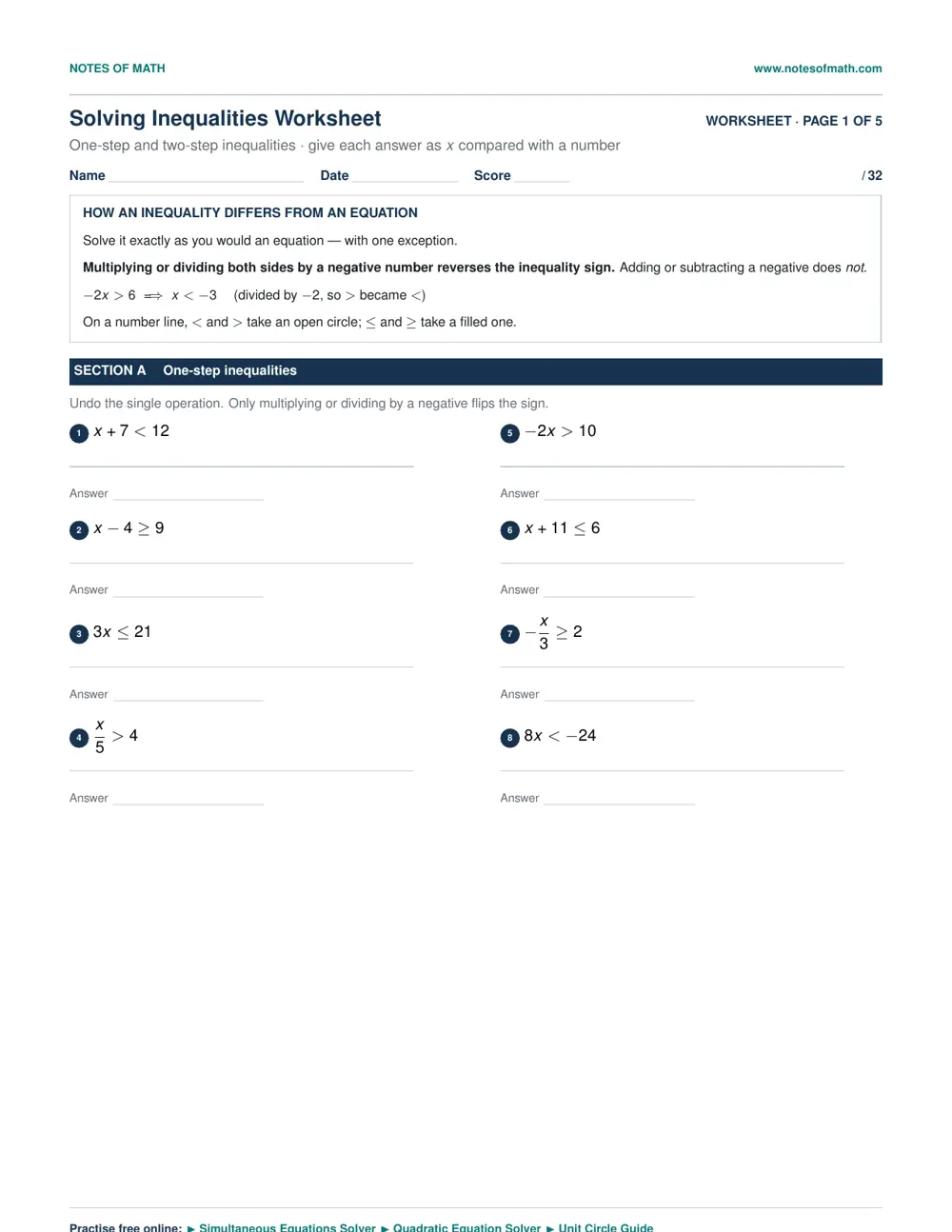
What is on the worksheet
- Section A — one-step inequalities (8 questions). A single operation to undo, including two that need a sign flip.
- Section B — two-step inequalities (8 questions). Undo the addition or subtraction first, then the multiplication or division.
- Section C — variables on both sides (6 questions). Including two that need the brackets expanded first.
- Section D — the sign flip (4 questions). Every question needs a division by a negative at some point.
- Section E — word problems (4 questions). Define the variable, write the inequality, solve it, answer in a sentence.
- Section F — explain your reasoning (2 questions). Why the sign reverses, and how an inequality’s solution differs from an equation’s.
- Answer key (3 pages). Each solution with the step that produced it.
How to solve an inequality
Solve it exactly as you would the matching equation — with one exception that applies to nothing else in algebra.
- Expand any brackets and collect like terms on each side.
- Move the variable terms to one side and the numbers to the other. Moving them to the side where the coefficient stays positive avoids a sign flip.
- Divide by the coefficient. If that coefficient is negative, reverse the inequality sign.
- Check by testing one number from your solution in the original inequality. If it does not hold, the sign is the first place to look.
Worked example: −2x > 6. Dividing both sides by −2 gives x < −3 — the sign reverses. Check it: x = −4 gives −2(−4) = 8, and 8 > 6 is true.
Why does dividing by a negative reverse the sign?
Multiplying by a negative reverses order on the number line. 3 is greater than 2, but −3 is less than −2. The same reversal happens to an inequality.
If you did not flip the sign when solving −2x > 6, you would get x > −3, which excludes −4 — yet −4 genuinely satisfies the original. Flipping keeps the statement true.
Graphing the solution on a number line
A strict inequality (< or >) takes an open circle at the boundary, because that value itself is not included. An inclusive one (≤ or ≥) takes a filled circle.
Shade in the direction the solution runs. For x < −3, the circle sits at −3 and the line is shaded to the left, showing that infinitely many values work — which is the real difference from an equation, where only one does.
The mistake to watch for
Flipping the sign when you did not need to. Adding or subtracting a negative never flips it — only multiplying or dividing both sides by a negative does. When in doubt, test a number from your answer in the original.
Frequently asked questions
When does the inequality sign flip?
Only when you multiply or divide both sides by a negative number. Adding or subtracting, however negative the number, never flips it.
How is solving an inequality different from solving an equation?
The algebra is identical apart from the sign flip. The difference is the answer: an equation usually has one solution, while an inequality has infinitely many — a range rather than a point.
What is the difference between an open and a closed circle?
An open circle means the boundary value is not included, used for < and >. A filled circle means it is included, used for ≤ and ≥.
Does the worksheet cover compound inequalities?
The word problems lead to single inequalities with a practical upper or lower bound. Compound inequalities with two boundaries are a separate skill.