
Exponent Rules Worksheet
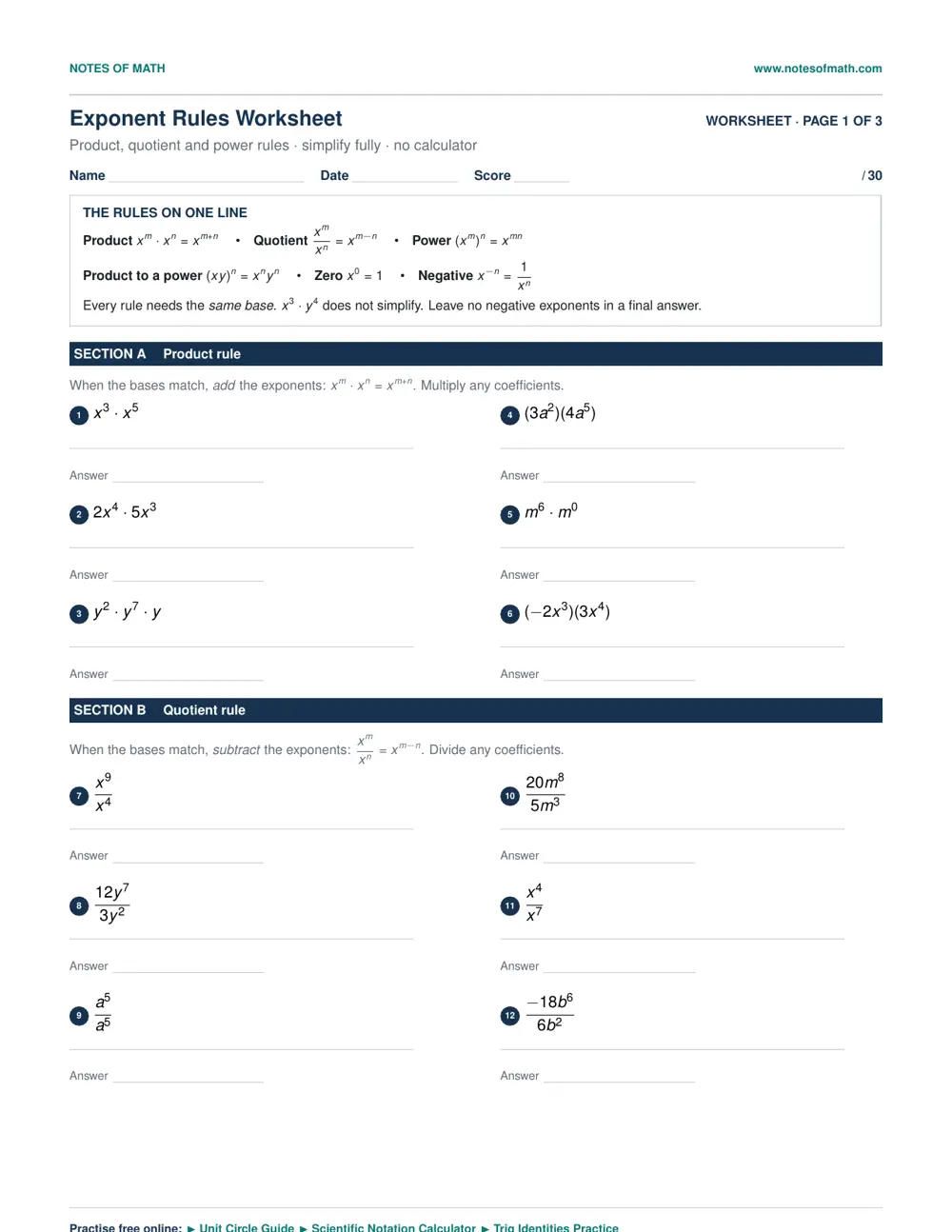
Practise all the laws of exponents on one free printable worksheet. It works through the product, quotient and power rules separately, then zero and negative exponents, and finishes with expressions that need several rules combined.
Download the worksheet
Three pages of practice and a two-page worked answer key, with the rule used named at every step.
What is on the worksheet
- Section A — product rule (6 questions). Matching bases, so the exponents add. Includes coefficients and negative signs.
- Section B — quotient rule (6 questions). Matching bases, so the exponents subtract, including cases that produce a negative exponent.
- Section C — power of a power and power of a product (6 questions). Exponents multiply, and an outside power reaches every factor inside.
- Section D — zero and negative exponents (6 questions). Including a negative exponent on a fraction.
- Section E — combined rules (4 questions). Expressions needing two or three rules in sequence.
- Section F — explain your reasoning (2 questions). Why x⁰ = 1, and the most common exponent error.
- Answer key (2 pages). Each simplification shown with the rule used.
The exponent rules in one place
Every rule below needs the same base. x³ · y⁴ does not simplify, because the bases differ.
- Product rule. xm · xn = xm+n — multiplying matching bases adds the exponents.
- Quotient rule. xm ÷ xn = xm−n — dividing subtracts them.
- Power of a power. (xm)n = xmn — raising a power to a power multiplies them.
- Power of a product. (xy)n = xnyn — the outside power applies to every factor, coefficients included.
- Zero exponent. x⁰ = 1 for any non-zero x.
- Negative exponent. x−n = 1 ÷ xn — move the factor across the fraction bar to make the exponent positive.
Worked example: (2x³)³ uses the power-of-a-product rule. The cube reaches both the 2 and the x³, giving 2³ · x⁹ = 8x⁹ — not 2x⁹.
Why does anything to the power of zero equal 1?
Apply the quotient rule to a fraction that is obviously equal to 1. x⁵ ÷ x⁵ = x⁵⁻⁵ = x⁰. But any non-zero number divided by itself is 1, so x⁰ must be 1.
The one exception is x = 0, since 0 ÷ 0 is undefined. That is why the rule is always stated for any non-zero base.
Negative exponents and where they go
A negative exponent is an instruction to move the factor to the other side of the fraction bar, flipping the sign of the exponent as it goes. 2x−4 becomes 2 ÷ x⁴, and 1 ÷ y−3 becomes y³.
A negative exponent never makes the value negative. 2−3 is 1/8, which is small and positive.
The mistake to watch for
Adding exponents when the rule calls for multiplying them. x³ · x⁴ = x⁷, because it is a product — but (x³)⁴ = x¹², because it is a power of a power. And the coefficient takes the outside power too: (2x⁵)³ = 8x¹⁵.
Frequently asked questions
What is the difference between exponent rules and laws of exponents?
Nothing — they are two names for the same set of rules. Some textbooks also call them the properties of exponents.
Can I use these rules when the bases are different?
No. Every rule here requires matching bases. x³ · y⁴ stays as it is. The one exception is the power-of-a-product rule, which distributes an outside power across different bases: (xy)³ = x³y³.
Does a negative exponent mean a negative answer?
No. It means a reciprocal. 2−3 is 1/8 — positive and less than 1. Only a negative base or coefficient makes a result negative.
Should the final answer have negative exponents in it?
Usually not. Convention is to rewrite every negative exponent as a positive one by moving the factor across the fraction bar. The worksheet asks for answers in that form.