Unit Circle Missions: Interactive Practice Game
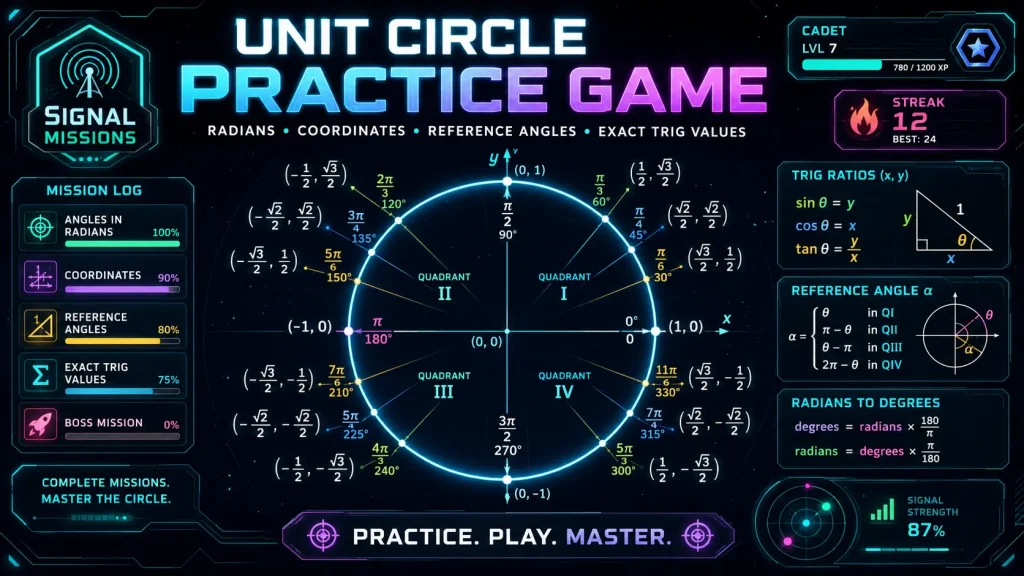
Use this unit circle practice game to master angles, radians, coordinates, reference angles, quadrant signs, and exact trig values. In Unit Circle Signal Quest, you complete signal missions, earn XP, build streaks, and learn how each part of the unit circle connects step by step.
This tool is useful for students preparing for a unit circle quiz, trigonometry test, pre-calculus class, or homework involving sine, cosine, tangent, radians, and coordinates.
Unit Circle Signal Quest
// decode angle signals, earn XP, and master radians, coordinates, and trig values
Re-lock the drifting angle beacon.
Every mission beams down a scrambled clue. Pick the matching unit-circle facts, launch the signal, and watch the beacon snap into place on the radar.
Radar Array
Transmission Log
Round 1Ready
Choose answer chips, then launch the signal to unlock the hidden point.
Calibration Dial
0 degreesCosine is x, sine is y
Every point on the unit circle sits at radius 1. The x-coordinate is cos(θ), the y-coordinate is sin(θ). That’s why the ordered pair is always (cos(θ), sin(θ)).
Reference angles carry the exact values
The 30, 45, and 60 degree families reuse the same positive sizes. The quadrant only flips the signs.
| Reference | |cos| | |sin| | |tan| |
|---|---|---|---|
| 30° | √3/2 | 1/2 | √3/3 |
| 45° | √2/2 | √2/2 | 1 |
| 60° | 1/2 | √3/2 | √3 |
Quadrants decide the signs
Quadrant I: cosine and sine both positive. Quadrant II: cosine negative, sine positive. Quadrant III: both negative. Quadrant IV: cosine positive, sine negative.
Radians are pieces of pi
180° equals π radians, so 30° is π/6, 45° is π/4, and 60° is π/3. Full-circle angles are fractions of 2π.
Boss Beacon
LockedBoss Board
ReadyBegin the run
Same reasoning, but the beacon stays hidden until you submit — and the clock never stops.
What Is Unit Circle Signal Quest?
Unit Circle Signal Quest is an interactive unit circle practice game built around signal missions. It gives you different angle-based clues and asks you to complete the missing unit circle information.
You may need to find the degree angle, radian measure, quadrant, reference angle, coordinate point, sine value, cosine value, or tangent value.
The goal is not only to guess the answer. The goal is to understand how each part of the unit circle is connected.
A point on the unit circle is written as:
\[
(\cos \theta, \sin \theta)
\]
This means cosine gives the x-coordinate, and sine gives the y-coordinate. Once you understand this pattern, unit circle coordinates and exact trig values become much easier.
If you are new to this topic, first review the Unit Circle Guide. After completing this practice tool, you can test your speed with the Unit Circle Game. You can also use the Circle Calculator to calculate radius, diameter, circumference, area, and related circle values.
How to Use This Unit Circle Practice Game
Start by reading the clue in the Transmission Log. Each mission gives you one part of the unit circle and asks you to complete the rest.
For example, the game may give you an angle such as:
\[
150^\circ
\]
Then you may need to choose its quadrant, reference angle, and coordinate point.
In another mission, the game may give you a coordinate such as:
\[
\left(-\frac{\sqrt{3}}{2}, \frac{1}{2}\right)
\]
Then you need to find the matching angle, radian measure, quadrant, and reference angle.
After you launch the signal, the game shows the correct signal and explains the relationship between the angle, coordinate, sine, cosine, and tangent values.
This makes the game useful for both learning and revision.
Earn XP, Build Streaks, and Level Up
Unit Circle Signal Quest also works like a real practice game. You earn XP for correct answers, build streaks when you solve missions correctly, and fill the level progress bar as you improve.
The game also includes combo rewards, sound effects, achievement pop-ups, and a Boss Run mode. These features make unit circle practice more active than a normal worksheet or quiz.
Challenge Yourself with 5 Signal Missions
This is not just a basic unit circle quiz. This unit circle practice game uses different mission types so you can practise the same concept from different directions.
Angle Signals
In Angle Signals, the game gives you an angle in degrees or radians. You must complete the missing unit circle information.
For example, if the angle is:
\[
210^\circ
\]
you should know that it lies in Quadrant III, has a reference angle of \(30^\circ\), and has the coordinate:
\[
\left(-\frac{\sqrt{3}}{2}, -\frac{1}{2}\right)
\]
This type of mission helps you practise degree angles, radian angles, quadrants, reference angles, and coordinates together.
Coordinate Signals
In Coordinate Signals, the game gives you a coordinate point on the unit circle. You must recover the matching angle facts.
For example:
\[
\left(\frac{1}{2}, -\frac{\sqrt{3}}{2}\right)
\]
This point is in Quadrant IV. Since the cosine value is positive and the sine value is negative, the angle is:
\[
300^\circ
\]
or
\[
\frac{5\pi}{3}
\]
This mission is useful for unit circle coordinates practice because it trains you to move from the coordinate back to the angle.
Sign and Reference Angle Signals
In this mission type, you use the signs of sine and cosine along with the reference angle.
For example, the game may tell you that:
\[
\cos \theta < 0
\]
\[
\sin \theta > 0
\]
and the reference angle is \(30^\circ\).
Since cosine is negative and sine is positive, the angle must be in Quadrant II. The angle with a \(30^\circ \) reference angle in Quadrant II is:
\[
150^\circ
\]
This is a good way to practise quadrant signs and reference angles instead of memorizing every unit circle value separately.
Trig Value Signals
In Trig Value Signals, the game gives you sine and cosine values. You use them to rebuild the unit circle profile.
For example:
\[
\sin \theta = \frac{\sqrt{2}}{2}
\]
\[
\cos \theta = -\frac{\sqrt{2}}{2}
\]
Since sine is positive and cosine is negative, the angle is in Quadrant II. The reference angle is \(45^\circ \), so the angle is:
\[
135^\circ
\]
or
\[
\frac{3\pi}{4}
\]
This mission helps students practise exact trig values in a more active way.
Tangent Signals
In Tangent Signals, you use the tangent value and quadrant information to identify the correct angle.
Tangent is found using:
\[
\tan \theta = \frac{\sin \theta}{\cos \theta}
\]
So tangent depends on both sine and cosine.
For example, if tangent is negative and cosine is positive, the angle is in Quadrant IV. Then you use the reference angle to find the exact angle.
This mission is helpful because tangent values often confuse students when they only memorize a chart.
Practice Unit Circle Coordinates
Unit circle coordinates are one of the most important parts of trigonometry.
Every point on the unit circle follows this rule:
\[
(\cos \theta, \sin \theta)
\]
The first value is cosine. The second value is sine.
For example:
\[
60^\circ = \frac{\pi}{3}
\]
The coordinate of \(60^\circ\) is:
\[
\left(\frac{1}{2}, \frac{\sqrt{3}}{2}\right)
\]
So:
\[
\cos 60^\circ = \frac{1}{2}
\]
and
\[
\sin 60^\circ = \frac{\sqrt{3}}{2}
\]
This unit circle practice game helps you connect the angle, radian measure, coordinate point, sine value, and cosine value together.
That is much better than learning each value as a separate fact.
Practice Reference Angles
Reference angles help you find exact values on the unit circle.
Most standard unit circle angles are based on these special angles:
\[
30^\circ,\quad 45^\circ,\quad 60^\circ
\]
or in radians:
\[
\frac{\pi}{6},\quad \frac{\pi}{4},\quad \frac{\pi}{3}
\]
The reference angle gives the basic value. The quadrant decides the sign.
For example:
\[
30^\circ
\]
and
\[
150^\circ
\]
both have a reference angle of \(30^\circ\).
But their coordinates are different because they are in different quadrants.
\[
30^\circ = \left(\frac{\sqrt{3}}{2}, \frac{1}{2}\right)
\]
\[
150^\circ = \left(-\frac{\sqrt{3}}{2}, \frac{1}{2}\right)
\]
The size of the values is the same, but the sign of cosine changes. This happens because \(150^\circ\) lies in Quadrant II.
This is why reference angle practice is so important. If you understand reference angles, the unit circle becomes much easier.
Practice Radians and Degrees
Many students know degree angles but struggle with radian measures.
This game helps you practise common degree and radian pairs such as:
\[
30^\circ = \frac{\pi}{6}
\]
\[
45^\circ = \frac{\pi}{4}
\]
\[
60^\circ = \frac{\pi}{3}
\]
\[
90^\circ = \frac{\pi}{2}
\]
\[
180^\circ = \pi
\]
\[
270^\circ = \frac{3\pi}{2}
\]
\[
360^\circ = 2\pi
\]
When you practise these values in missions, you learn how radians, degrees, coordinates, and exact trig values connect.
This makes the tool useful for students who need unit circle practice before a quiz or test.
Practice Exact Trig Values
Exact trig values are easier when you understand the pattern.
For the \(30^\circ\) family:
\[
\sin 30^\circ = \frac{1}{2}
\]
\[
\cos 30^\circ = \frac{\sqrt{3}}{2}
\]
For the \(45^\circ\) family:
\[
\sin 45^\circ = \frac{\sqrt{2}}{2}
\]
\[
\cos 45^\circ = \frac{\sqrt{2}}{2}
\]
For the \(60^\circ\) family:
\[
\sin 60^\circ = \frac{\sqrt{3}}{2}
\]
\[
\cos 60^\circ = \frac{1}{2}
\]
After learning these base values, you only need to apply the correct quadrant signs.
This interactive unit circle practice game helps you build that habit through repeated missions.
Unit Circle Practice vs Unit Circle Game
This page is made for guided practice. It is best for students who want to understand the unit circle step by step.
The Unit Circle Game is better for fast recall, speed practice, and quick review.
Use this page when you want to practise:
Unit circle coordinates
Reference angles
Radians and degrees
Quadrant signs
Exact sine values
Exact cosine values
Exact tangent values
Mission-based unit circle practice
Use the Unit Circle Game when you want to test your speed after learning the main patterns.
Both tools are useful, but they are not the same.
This page is a guided unit circle practice tool. The other page is a faster unit circle game for speed and recall..
Who Should Use This Unit Circle Practice Tool?
This tool is useful for students studying trigonometry, pre-calculus, Algebra 2, or any topic that includes the unit circle.
You should use this tool if you need help with:
Converting degrees to radians
Finding unit circle coordinates
Remembering exact trig values
Finding reference angles
Understanding quadrant signs
Preparing for a unit circle quiz
Practising sine, cosine, and tangent values
It is also useful if you already know the basic unit circle chart but still make mistakes when signs, radians, and coordinates are mixed together.
Best Way to Study With This Game
Start with the Calibration Bay first. Click through the standard angles and observe how the coordinates change.
Then play the mission rounds. Do not rush at the beginning. Try to understand why each answer is correct.
After that, try the Boss Run. This mode is better for testing your speed after you have practised the patterns.
If you make a mistake, look at the explanation carefully. Ask yourself where the mistake happened.
Was it the quadrant?
Was it the reference angle?
Was it the radian measure?
Was it the coordinate point?
Was it the sine, cosine, or tangent value?
This method will help you improve faster than only looking at a unit circle chart.
Common Unit Circle Mistakes
Many students confuse sine and cosine.
Remember:
\[
(\cos \theta, \sin \theta)
\]
Cosine is the x-coordinate. Sine is the y-coordinate.
Another common mistake is using the right value but the wrong sign. Always check the quadrant before choosing the final coordinate.
Students also confuse \(30^\circ\) and \(60^\circ\).
For \(30^\circ\), the sine value is smaller:
\[
\sin 30^\circ = \frac{1}{2}
\]
For \(60^\circ\), the sine value is larger:
\[
\sin 60^\circ = \frac{\sqrt{3}}{2}
\]
Another mistake is mixing degree and radian values.
For example:
\[
30^\circ = \frac{\pi}{6}
\]
but
\[
60^\circ = \frac{\pi}{3}
\]
This unit circle practice game helps reduce these mistakes by making you connect all parts of the angle together.
Final Words
Unit Circle Signal Quest is an interactive unit circle practice tool for learning angles, radians, coordinates, reference angles, quadrant signs, and exact trig values.
It is useful when you want guided practice before moving to faster speed challenges.
Start with the Calibration Bay, complete the missions, and then try the Boss Run. After that, you can use the Unit Circle Game to test your speed and memory.
Together, both tools can help you learn the unit circle more clearly and prepare for quizzes, homework, and trigonometry tests. Browse the complete collection of free math games online for arithmetic, fractions, algebra, trigonometry, and number skills.
FAQs
What is unit circle practice?
Unit circle practice means reviewing and solving questions about unit circle angles, radians, coordinates, reference angles, quadrant signs, and exact trig values.
What is Unit Circle Signal Quest?
Unit Circle Signal Quest is an interactive unit circle practice game where students complete signal missions, earn XP, build streaks, and practise radians, coordinates, reference angles, quadrants, and exact trig values.
Is this different from the Unit Circle Game?
Yes. This page focuses on step-by-step unit circle practice. The Unit Circle Game focuses more on fast recall and speed-based practice.
What does a unit circle coordinate mean?
A unit circle coordinate is written as \((\cos \theta, \sin \theta)\). The x-coordinate is cosine, and the y-coordinate is sine.
Why are reference angles important?
Reference angles help you find exact trig values. The reference angle gives the basic value, and the quadrant decides whether the value is positive or negative.
Can I use this before a unit circle quiz?
Yes. This tool is useful before a unit circle quiz because it helps you practise radians, coordinates, exact trig values, and quadrant signs.
Does this game help with radians?
Yes. The game includes common radian values such as \(\frac{\pi}{6}\), \(\frac{\pi}{4}\), \(\frac{\pi}{3}\), \(\frac{\pi}{2}\), \(\pi\), and other standard unit circle radians.
What should I memorize for the unit circle?
You should memorize the standard degree angles, radian measures, coordinate points, quadrant signs, and exact sine, cosine, and tangent values.
How do I get better at the unit circle?
Start with the 30°, 45°, and 60° reference angle families. Then practise quadrant signs, coordinates, radians, and exact trig values. This unit circle practice game helps you practise all of these together.